



Panama - Grupo L
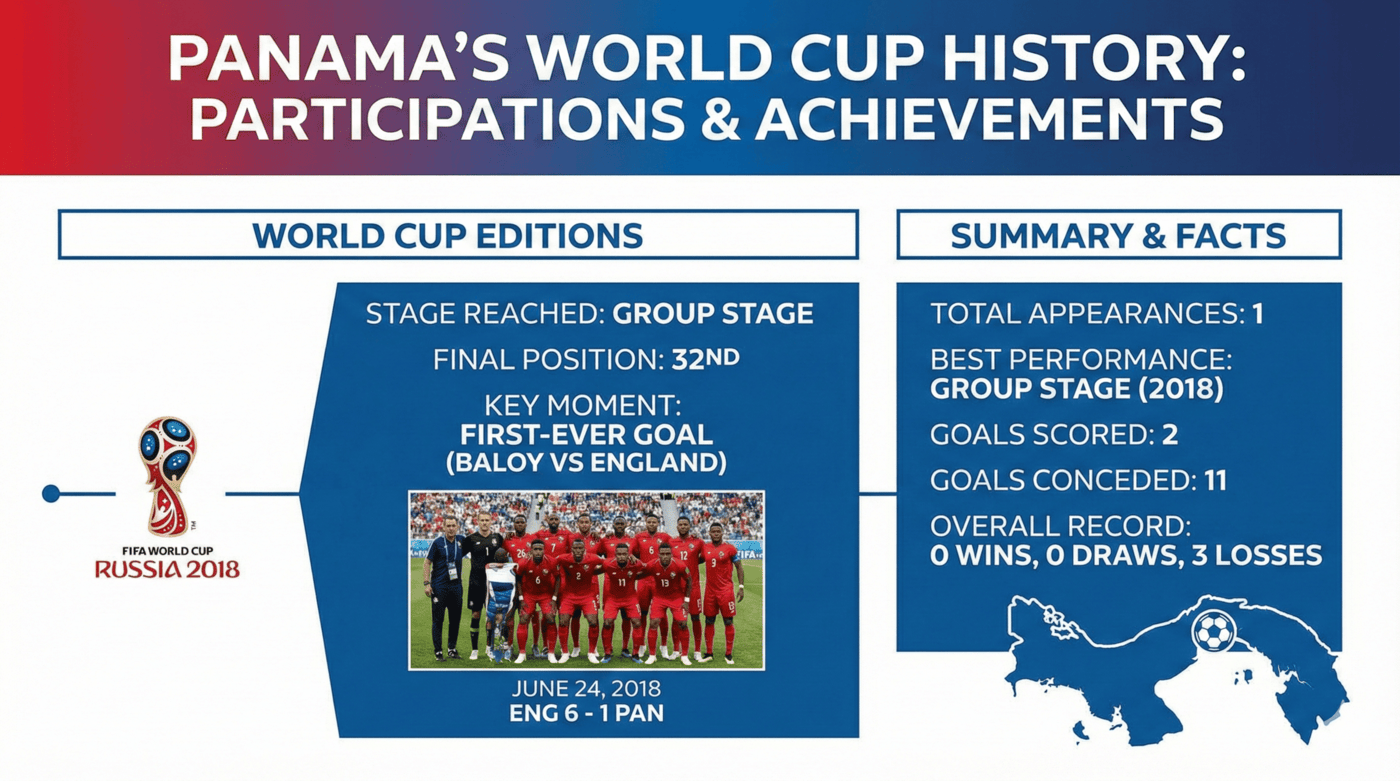
Panama 🇵🇦🔥 From the Canal to the Big Stage
A qualifying run built on clean sheets, late grit, and a team that learned how to win without fireworks.
Introduction
Panama’s road to a World Cup never looks like a straight highway. It’s more like a coastal route with sudden rain, tricky curves, and the kind of stop-and-go rhythm that forces you to win games in different ways. Sometimes it’s a composed 2–0 at home with the crowd pushing the last five minutes. Other times it’s a 0–0 away that doesn’t sparkle, but quietly keeps the engine running.
What stands out from this cycle is not one single blockbuster night—it’s the steady accumulation of points, the habit of staying alive inside matches, and the refusal to turn good moments into drama. Panama didn’t qualify by being perfect; it qualified by being reliable. And in CONCACAF, reliability is a weapon.
The numbers land with clarity. Across the stages shown here, Panama finish top in both of their relevant standings snapshots: first in Second Round Group D with 12 points from 4 matches and a goal difference of +9, and first in Third Round Group A with 12 points from 6 matches and a goal difference of +5. Two different contexts, two different versions of the same idea: Panama set a floor—then played above it.
Even the goal profile tells a story. In the Second Round they blast through with 10 goals scored and just 1 conceded. In the Third Round, the game tightens, the margins shrink, and Panama adapt: 9 scored, 4 conceded, and three draws that never turn into collapses. That’s not just “good defense.” That’s a team that understands game states.
There are hinge moments that shape the narrative. On 6 June 2024, Panama open with a 2–0 win over Guyana in Panama City—clean, professional, no fuss. On 9 June 2024, away against Montserrat (played in Managua), they go further: 3–1, with goals spread and control sustained. Then the campaign’s mood shifts in the Third Round: on 14 October 2025 at the Rommel Fernández, Panama rescue a 1–1 against Suriname with Ismael Díaz scoring at 90+6’. That’s not a stat; that’s a pulse. Finally, the defining away statement arrives on 13 November 2025: Panama win 3–2 in Guatemala City, taking a punch in the second half and still walking out with three points.
And now the calendar offers the biggest stage: Group L at the World Cup, with Ghana, Croatia, and England. Three matches, three different problems to solve, all of them under bright lights.
The Road Through Qualifiers
CONCACAF qualifying in this cycle is built in layers: an early stage, then a Second Round group phase, then a Third Round group phase. The portion reflected in the provided match list begins in the Second Round and continues into the Third Round. The key structure is simple in principle and unforgiving in practice: group games, home-and-away rhythms, and a points race that punishes careless draws.
The Second Round is where Panama first lay down their marker. Group D is a five-team table, and Panama make it look like a four-game sprint: 4 played, 4 won, 10 scored, 1 conceded. Twelve points, maximum return. There’s a particular confidence in that kind of record—not because it always predicts future dominance, but because it shows you can handle obligation matches. The kind you must win, even when the opponent sits deep and the crowd grows impatient.
The match sequence is clean and symmetrical: two games in June 2024, two games in June 2025. On 6 June 2024, Panama beat Guyana 2–0 in Panama City, with Cristian Martínez and José Luis Rodríguez on the scoresheet. Three days later, on 9 June 2024, they win 3–1 away to Montserrat (in Managua), with Jovani Welch, José Fajardo, and again José Luis Rodríguez scoring. That early two-game burst matters: it gives Panama air, gives them margin, and forces everyone else to chase.
In June 2025, the second pair of matches complete the job. On 7 June 2025, Panama win 2–0 away at Belize in Belmopán, and on 10 June 2025 they close with a 3–0 home win over Nicaragua. Notice the pattern: away clean sheet, then a home statement. Across the four games, Panama concede once—on neutral soil against Montserrat—and never again. That’s not luck across four matches; it’s a defensive baseline.
Then comes the Third Round—and the tone changes immediately. Group A is a four-team mini-league: Panama, Suriname, Guatemala, and El Salvador. Home-and-away within the group means six matches, and that inevitably produces a more tactical rhythm. Here, Panama do not go 6-for-6. Instead they go unbeaten: 3 wins, 3 draws, 0 losses. That “0 losses” is the headline, because it keeps the mathematics in your favor and forces rivals to do the risky part.
The Third Round begins with two draws that could have been read as warning signs—if you ignore everything else. On 4 September 2025, Panama draw 0–0 away to Suriname in Paramaribo. Then on 8 September 2025, they draw 1–1 at home to Guatemala. The details of the second draw are instructive: Panama score through “Harvey” at 37’, Guatemala through Santis at 35’. That’s a match decided by two moments close together—an early emotional swing, the kind that often turns into chaos. It didn’t. Panama stayed stable.
October is where Panama turn the table pressure into points. On 10 October 2025, they win 1–0 away at El Salvador in San Salvador, José Fajardo scoring at 55’. And four days later, on 14 October 2025, they draw 1–1 at home against Suriname—after conceding at 21’ and equalizing at 90+6’ through Ismael Díaz. That draw is more than one point: it prevents a loss, keeps Suriname from stealing a psychological victory, and shows Panama can chase without losing structure.
November is Panama’s decisive swing. On 13 November 2025, they win 3–2 away at Guatemala. Two goals from Waterman (30’, 44’) and another from Fajardo (78’) outweigh Guatemala’s late push (goals at 69’ and 72’). Five days later, on 18 November 2025, Panama beat El Salvador 3–0 at home, with Blackman (17’), Davis (penalty 45+4’), and J. Rodríguez (85’) scoring. That final home match looks like a curtain call, but it is also a summary: early lead, controlled advantage, and a late third goal to remove doubt.
Below is the full match log for Panama from the provided dataset.
| Date | Round | Group | Opponent | Venue status | Result | Goalscorers | City | Stadium |
|---|---|---|---|---|---|---|---|---|
| 6 June 2024 | Second Round | D | Guyana | Home | Panama 2–0 Guyana | Cristian Martínez, José Luis Rodríguez (Panama) | Panama City | |
| 9 June 2024 | Second Round | D | Montserrat | Away | Montserrat 1–3 Panama | Kaleem Simon (Montserrat); Jovani Welch, José Fajardo, José Luis Rodríguez (Panama) | Managua | |
| 7 June 2025 | Second Round | D | Belize | Away | Belize 0–2 Panama | Fidel Escobar, Eduardo Guerrero (Panama) | Belmopán | |
| 10 June 2025 | Second Round | D | Nicaragua | Home | Panama 3–0 Nicaragua | César Yanis, Ismael Díaz, Eric Davis (Panama) | Panama City | |
| 4 September 2025 | Third Round | A | Suriname | Away | Suriname 0–0 Panama | No goals | Paramaribo | Stadium Franklin Essed |
| 8 September 2025 | Third Round | A | Guatemala | Home | Panama 1–1 Guatemala | Harvey (37'); Santis (35') | Panama City | Stadium Rommel Fernández |
| 10 October 2025 | Third Round | A | El Salvador | Away | El Salvador 0–1 Panama | Fajardo (55') | San Salvador | Stadium Cuscatlán |
| 14 October 2025 | Third Round | A | Suriname | Home | Panama 1–1 Suriname | Díaz (90+6'); Margaret (21') | Panama City | Stadium Rommel Fernández |
| 13 November 2025 | Third Round | A | Guatemala | Away | Guatemala 2–3 Panama | Ordóñez (69'), Muñoz (72'); Waterman (30', 44'), Fajardo (78') | Guatemala City | Stadium Manuel Felipe Carrera |
| 18 November 2025 | Third Round | A | El Salvador | Home | Panama 3–0 El Salvador | Blackman (17'), Davis (45+4' pen.), J. Rodríguez (85') | Panama City | Stadium Rommel Fernández |
Now, the standings context—presented exactly as it appears in the dataset, including both rounds.
Table 1 Second Round Group D
| Pos | Team | Pts | GP | W | D | L | GF | GA | GD |
|---|---|---|---|---|---|---|---|---|---|
| 1 | Panama | 12 | 4 | 4 | 0 | 0 | 10 | 1 | +9 |
| 2 | Nicaragua | 9 | 4 | 3 | 0 | 1 | 9 | 4 | +5 |
| 3 | Guyana | 6 | 4 | 2 | 0 | 2 | 6 | 4 | +2 |
| 4 | Montserrat | 3 | 4 | 1 | 0 | 3 | 3 | 10 | −7 |
| 5 | Belize | 0 | 4 | 0 | 0 | 4 | 1 | 10 | −9 |
Table 2 Third Round Group A
| Pos | Team | Pts | GP | W | D | L | GF | GA | GD |
|---|---|---|---|---|---|---|---|---|---|
| 1 | Panama | 12 | 6 | 3 | 3 | 0 | 9 | 4 | +5 |
| 2 | Suriname | 9 | 6 | 2 | 3 | 1 | 9 | 6 | +3 |
| 3 | Guatemala | 8 | 6 | 2 | 2 | 2 | 8 | 7 | +1 |
| 4 | El Salvador | 3 | 6 | 1 | 0 | 5 | 2 | 11 | −9 |
Read those two tables together and you see the arc. In the Second Round, Panama are a front-runner: they lead from the front, outscore the group heavily, and barely concede. In the Third Round, Panama are a finisher: they manage draws, avoid losses, then strike in October and November with the decisive away win in Guatemala City and the emphatic home win over El Salvador.
A few performance splits jump off the page even without deeper event data:
- Home matches in this list: 5 games, 4 wins, 1 draw, 0 losses. Goals: 10 scored, 2 conceded. That’s a home base that doesn’t wobble.
- Away matches in this list: 5 games, 3 wins, 2 draws, 0 losses. Goals: 8 scored, 3 conceded. That’s not just “survive away”—that’s go and take points.
- One-goal games: the 1–0 at El Salvador and the two 1–1 draws in the Third Round show Panama can live in thin margins.
- Shutouts: Panama keep clean sheets in 6 of the 10 matches listed. In qualification football, that’s often the difference between “competing” and “advancing.”
And the strongest single indicator of tournament readiness might be this: in the Third Round, Panama concede first against Suriname at home (21’) and still avoid defeat with a 90+6’ equalizer. In Guatemala City, they are 2–0 up, then concede twice in three minutes (69’ and 72’) and still win 3–2. Those are two different stress tests, and Panama pass both.
How they play
Without pretending to draw a full tactical blueprint from scorelines alone, Panama’s identity across these matches is still readable. The team profile is built around control of risk. They don’t need to win every game with a two-goal cushion; they just need to keep the match inside a manageable frame until their moments arrive.
Start with the defensive evidence. Across 10 matches listed, Panama concede 5 goals total—an average of 0.5 per game. In the Second Round they allow 1 in 4, and in the Third Round they allow 4 in 6. That increase is normal when the opponent quality rises. The important part is what doesn’t change: Panama never concede more than two in a match, and they never lose. Even the “messiest” night, the 3–2 in Guatemala City, is still a night where Panama score three and keep enough structure to protect the lead after the equalizing shock.
Then there’s the rhythm of winning. Panama’s wins come in different shapes:
- Comfortable multi-goal wins: 2–0 vs Guyana, 2–0 at Belize, 3–0 vs Nicaragua, 3–0 vs El Salvador.
- Controlled narrow wins: 1–0 at El Salvador.
- High-stress, high-value win: 3–2 at Guatemala.
That variety matters for a World Cup group, where you might need one match to be patient and another to be ruthless. Panama have rehearsed both.
Goal distribution also suggests a team that doesn’t live and die with one name. Over these 10 games, the scorers list includes Cristian Martínez, José Luis Rodríguez, Jovani Welch, José Fajardo, Fidel Escobar, Eduardo Guerrero, César Yanis, Ismael Díaz, Eric Davis, Waterman, Blackman—plus “J. Rodríguez” appearing again later. Even allowing for naming variations, that is a wide spread. Panama can win with a striker’s finish (Fajardo), a defender’s contribution (Escobar, Davis), and late-game impact (Díaz at 90+6’). That diversity reduces predictability.
The draw profile in the Third Round is equally revealing: three draws in six games, two of them 1–1 and one 0–0. That’s not a team trapped in sterile possession; it’s a team that can accept a point when it protects the campaign’s geometry. The 0–0 away to Suriname reads like a deliberate exercise in game management: no goals conceded, no damage done, keep the group table under control. The 1–1 draws—especially the late equalizer against Suriname—show Panama can chase without turning the match into a coin flip.
As for vulnerabilities, the scorelines hint at two scenarios that test Panama:
- The “first goal against” scenario. Conceding early at home against Suriname forced a rescue mission. Panama did rescue it—but a World Cup opponent may punish that earlier.
- The “momentum swing” scenario. In Guatemala City, Panama concede twice in three minutes. They still win, which is a positive, but it also signals how quickly a match can change when the opponent finds a wave. The lesson is clear: Panama’s best version is the one that avoids giving the opponent a second wind.
If you want the simplest performance summary: Panama are a team that win more often than they lose control. And in international football, that’s the closest thing to a portable skill.
The Group at the World Cup
Group L gives Panama three different tasks, and it gives them in a specific order. First Ghana, then Croatia, then England. Two matches in Toronto at BMO Field, then a final group match at MetLife Stadium in New York / New Jersey. Even without diving into opponent scouting, the logistical pattern matters: settle in one venue early, build routine, then handle a late move for the closer.
The fixture list provided is clear, and it frames the story like a short series:
| Date | City | Stadium | Opponent |
|---|---|---|---|
| 17 June 2026 | Toronto | BMO Field | Ghana |
| 23 June 2026 | Toronto | BMO Field | Croatia |
| 27 June 2026 | New York / New Jersey | MetLife Stadium | England |
The opener against Ghana is the classic World Cup hinge match. Not because it “defines everything” in a dramatic sense, but because it sets the emotional temperature. Panama’s qualifying data suggests they handle openers well: their Second Round starts with a 2–0, and their Third Round starts with a 0–0 away that keeps stability. So the likely Panama approach is pragmatic: reduce volatility early, avoid conceding first, and keep the match alive into the second half where a set-piece, a transition, or a late push can tilt the points.
Prediction in plain language: draw.
The second match, against Croatia, is where tournament math begins to speak louder than the heart. Panama’s best evidence-based weapon here is their ability to live in tight scorelines. In the Third Round, three of six matches are draws, and one of their wins is 1–0 away—exactly the kind of “thin-margin” result that can steal points against a stronger paper opponent. If Panama take something from Matchday 1, this becomes a match where patience is not passive: it is strategic.
Prediction in plain language: draw.
The final match against England comes at MetLife Stadium. Final group matches can turn into strange games: sometimes a sprint, sometimes a chessboard, depending on standings. Panama’s qualification profile suggests they are comfortable with pressure late in cycles—November is their strongest window in the Third Round, with the 3–2 away win and the 3–0 home close. That said, without assuming any specific opponent trends from outside this dataset, the cautious read is that Panama will need their sharpest defensive discipline and their cleanest transitions.
Prediction in plain language: England win.
The key for Panama is that “qualification talk” cannot be reduced to one match. The group is a three-act play, and Panama’s qualifying behavior points to a realistic script: stay unbeaten as long as possible, keep goal difference respectable, and arrive to the final match with something still on the table.
Keys to qualification for Panama:
- Win the first 30 minutes of each match emotionally: no early concession, no cheap fouls, no frantic clearances.
- Turn draws into assets, not regrets: Panama’s Third Round showed how a point can be campaign gold.
- Keep clean sheets as a target, not a hope: 6 clean sheets in 10 qualifiers is the best evidence of a World Cup-ready baseline.
- If chasing late, chase with structure: the 90+6’ equalizer vs Suriname is the model—urgent, but not reckless.
- Protect against momentum swings: the three-minute concession burst in Guatemala City is the warning label.
Editorial opinion
Panama earned this ticket the hard way: not with a single night that becomes folklore, but with a month-by-month accumulation of small, correct decisions. That is a compliment with teeth. Because at the World Cup, glamour is optional, but survival is mandatory. And Panama’s qualifying story is, above all, a survival manual—how to keep the match within reach, how to take points without needing perfection, how to walk out of hostile stadiums with something in your pocket.
Still, there’s a thin line between “mature” and “too comfortable.” Three draws in six Third Round matches are not a flaw by default, but they are a reminder: Panama can live in low-scoring games, and that’s useful—until it becomes habit. The World Cup doesn’t always give you a late equalizer, and it doesn’t always forgive a slow start. The team must carry its defensive floor to Group L, yes, but also be ready to turn one of those tight matches into a win.
The campaign leaves one concrete warning you can pin to a date and a match: 13 November 2025 in Guatemala City, Panama conceded twice in three minutes and suddenly needed a third goal to escape. They did escape—and that’s the beauty of it. But the World Cup version of that sequence can be terminal. If Panama want to write a new chapter, the lesson is simple: keep the calm that carried them, and don’t gift the tournament a window to swing.
Because Panama’s best quality is not a secret system or a single star. It’s the stubborn ability to keep standing. And sometimes, that’s how stories become history.