

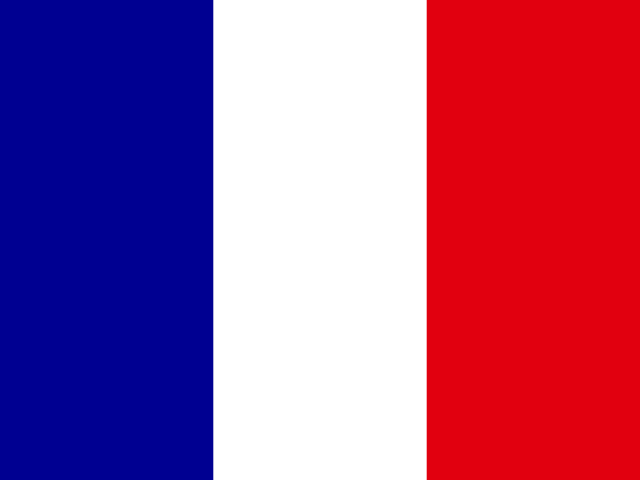
France - Grupo I

🇫🇷 France, the qualifier that never blinked
A ruthless UEFA run, a few sharp turns in the road, and a World Cup group that asks for control, not noise.
Introduction
The first image is almost always the same: France walking into a qualifying window like it owns the air in the stadium. Not with speeches, not with theatrical promises—just with that calm tempo that makes the opponent feel late to every duel. In Group D, the story read like a team that knows exactly what it wants: points first, margins later, and only then the luxury of style.
Still, it wasn’t a straight line drawn with a ruler. It was more like a disciplined march with a couple of moments where the match tried to turn into something else—scrappy, emotional, chaotic—and France simply refused the invitation. When the game asked for patience, they waited. When it asked for teeth, they showed them. That’s how campaigns become qualifications before they become narratives.
On the numbers, France finish top of Group D with 16 points from 6 matches: 5 wins, 1 draw, 0 losses. The goal profile is the kind coaches frame on a wall: 16 scored, 4 conceded, +12 goal difference. It’s not just dominance; it’s dominance without the usual “one bad afternoon” that often sneaks into modern qualifying.
Three hinge moments define the rhythm of the campaign. First, the opener that set the tone away from home: 5 September 2025, Ukraine 0–2 France, with Olise striking early at 10' and Mbappé sealing it at 82'. Second, the match that introduced tension inside the group even with a win: 9 September 2025, France 2–1 Iceland—Mbappé from the spot at 45' and Barcola at 62', but Iceland landing an early punch through An. Guðjohnsen at 21'. And third, the only match where France didn’t take all three points: 13 October 2025, Iceland 2–2 France, where Nkunku and Mateta flipped the script in five minutes, only for Iceland to pull them back into a draw.
Those three games carry the whole arc: start fast, absorb pressure, respond when things wobble. And by the time the campaign reached its final stretch, France weren’t just winning—they were tightening the screws. The 4–0 over Ukraine on 13 November 2025 felt like a closing statement, not a highlight reel: penalties, late goals, and the kind of scoreboard that turns a group table into an obituary.
Qualifying campaigns are often won in the margins: the away clean sheet, the refusal to gift a second chance, the ability to score without opening the back door. France’s Group D run was exactly that—high-level efficiency with enough attacking punch to make the difference obvious, but not so much chaos that the team ever looked exposed.
The Road Through Qualifiers
France’s route came through UEFA Group D, and the table tells you two things at once: France were clearly the best team in the group, and Ukraine were the only side that could credibly keep the race alive on paper. France ended with 16 points; Ukraine with 10. That six-point gap across a six-game schedule is the distance between “in the conversation” and “done and dusted.”
The standings also underline how France built separation. The defensive number—4 goals conceded in 6 matches—is the backbone. But the attack didn’t merely do enough; it did damage: 16 goals across 6 matches, an average of 2.67 goals scored per game. Put those two together and you get a campaign that is not just winning, but winning in a repeatable way.
Ukraine, the runner-up, finished with 10 goals scored but 11 conceded, a negative goal difference. That’s not a detail—it’s the whole difference between competing and controlling. Iceland, for all their personality and their two-goal home draw against France, end with a positive goal difference (+2) but only 7 points, which hints at a team that could score but couldn’t consistently turn goals into wins. Azerbaijan were never truly in the race: 1 point, 3 scored, 16 conceded.
France’s match-by-match path shows a team that handled three different types of tests. There were “professional wins” away from home (Ukraine away, Azerbaijan away). There were “assertions” at home (3–0 vs Azerbaijan, 4–0 vs Ukraine). And there was the one match that forced them to solve a moving problem rather than a static one: the 2–2 away draw in Reykjavik.
If you zoom in on the timing of goals, you find an important trait: France score early enough to take control, and late enough to punish opponents who chase. Against Ukraine away, Olise’s 10' goal is a tone-setter. Against Azerbaijan away, conceding at 4' could have been the classic trap—early punch, crowd awake, game messy. France didn’t panic: Mateta equalized at 17', Akliouche put them ahead at 30', and then an own goal at 45' made the second half manageable. That sequence—respond quickly, build a cushion, kill uncertainty before halftime—looks like a habit, not a coincidence.
At home, the pattern changes slightly: France allow themselves to grow into the match and then strike with authority. Versus Iceland at home, they went behind at 21', but still reached halftime in front via Mbappé’s 45' penalty. Against Ukraine at home, Mbappé’s penalty at 55' opened the floodgates, with Olise at 76' and late goals at 83' and 88'. It’s a profile of a team that can win games in different chapters: early control, mid-game adjustment, late punishment.
And then there’s the campaign’s one “almost”: Iceland 2–2 France on 13 October 2025. France scored twice in five minutes—Nkunku 63', Mateta 68'—which usually signals a team taking the match away. Iceland answered at 70' through Hlynsson. That’s not a collapse, but it is the campaign’s clearest warning sign: when a game becomes exchange-heavy, France can be pulled into a rhythm where the opponent gets oxygen.
Below, the full match log for France in this qualifying run.
Table 1: France matches in UEFA Group D
| Date | Matchday | Opponent | Venue | Result | France scorers | Stadium |
|---|---|---|---|---|---|---|
| 5 September 2025 | Group D | Ukraine | Away | 0–2 | Olise 10', Mbappé 82' | Breslavia (Poland), Municipal Stadium |
| 9 September 2025 | Group D | Iceland | Home | 2–1 | Mbappé 45' pen., Barcola 62' | Paris, Parc des Princes |
| 10 October 2025 | Group D | Azerbaijan | Home | 3–0 | Mbappé 45+2', Rabiot 69', Thauvin 84' | Paris, Parc des Princes |
| 13 October 2025 | Group D | Iceland | Away | 2–2 | Nkunku 63', Mateta 68' | Reykjavik, Laugardalsvöllur |
| 13 November 2025 | Group D | Ukraine | Home | 4–0 | Mbappé 55' pen., 83', Olise 76', Ekitike 88' | Paris, Parc des Princes |
| 16 November 2025 | Group D | Azerbaijan | Away | 1–3 | Mateta 17', Akliouche 30', Magomedaliyev 45' og | Baku, Tofiq Bəhramov Stadium |
Now the full group table, complete and uncut, because context matters: France didn’t qualify in a vacuum—they separated themselves from three different competitive profiles.
Table 2: Group D standings
| Pos | Team | Pts | Played | W | D | L | GF | GA | GD | Status |
|---|---|---|---|---|---|---|---|---|---|---|
| 1 | France | 16 | 6 | 5 | 1 | 0 | 16 | 4 | +12 | World Cup 2026 |
| 2 | Ukraine | 10 | 6 | 3 | 1 | 2 | 10 | 11 | −1 | play-offs |
| 3 | Iceland | 7 | 6 | 2 | 1 | 3 | 13 | 11 | +2 | Not qualified |
| 4 | Azerbaijan | 1 | 6 | 0 | 1 | 5 | 3 | 16 | −13 | Not qualified |
The segmentation of results adds texture. Home record: three matches, three wins, 9 goals scored, 1 conceded—an almost clinical home base. Away record: three matches, two wins and one draw, 7 scored, 3 conceded—still strong, but with the only points dropped and the only match where the opponent reached two goals.
Another useful cut: “one-goal games.” France played one match decided by a single goal: 2–1 vs Iceland at home. Everything else was either a draw or a win by two or more goals. That suggests two things: they avoided coin-flip endings, and when they won, they generally created a cushion.
In terms of streaks, the campaign never had the emotional dip of a loss. The draw in Iceland didn’t grow into a hangover; it was followed by the 4–0 against Ukraine. That is often the real mark of a top team in qualifiers: not perfection, but the ability to convert the one imperfect evening into fuel rather than friction.
Finally, the attack’s rhythm across the windows matters. France scored in every match. They also kept three clean sheets (Ukraine away, Azerbaijan home, Ukraine home). When you score every time and blank the opponent half the time, the campaign becomes less about “if” you qualify and more about “how quickly” the table admits it.
How they play
France’s identity here can be inferred from what they consistently produced: controlled matches with repeated scoring patterns and minimal concessions. The campaign is not defined by wild scorelines every week; it is defined by repeatability. Three clean sheets in six matches and only four goals allowed total tell you that France were rarely dragged into shootouts. Even their 4–0 statement against Ukraine reads like a team that builds a win rather than chases a spectacle.
The first big clue is how France handle momentum swings. Against Iceland at home, they conceded first (21')—a classic scenario where teams either rush or reset. France reset, reached halftime ahead, and then found the second goal through Barcola at 62'. That suggests patience with a plan: they don’t need to win the match in ten angry minutes. They can let the game breathe and still end it on their terms.
The second clue is their response away from home. In Baku, conceding at 4' is exactly the kind of accident that can turn an away game into a survival test. France responded with three goals before halftime was even over, including pressure-induced damage like the 45' own goal. That’s not just quality; it’s composure and sequencing. A team that panics after conceding early often overextends and concedes again. France did the opposite: they stabilized, then accelerated.
The numbers support an attack that doesn’t rely on a single kind of match script. France scored 16 total goals. They scored early (10' vs Ukraine), they scored at the end of first halves (45' penalty vs Iceland, 45+2' vs Azerbaijan), and they scored late (82', 83', 84', 88'). That spread matters: it suggests their scoring isn’t dependent on one phase of play. They can hurt opponents at the start, before halftime, and when legs fade.
There is, however, a clear centerpiece in the scoring: Mbappé. He appears repeatedly and decisively—goals in Ukraine away, Iceland home, Azerbaijan home, and twice against Ukraine at home. Even without calculating an exact share, the frequency alone indicates a gravitational pull around him in the final third: when France need certainty, his name shows up. But the campaign also shows secondary routes: Olise scoring in both Ukraine matches, plus contributions from Barcola, Rabiot, Thauvin, Nkunku, Mateta, and Ekitike, and even an own goal forced in Baku. That is an important balance: a star finisher, but not a one-man attack.
Defensively, the vulnerability appears in one specific kind of scenario: when the opponent can keep the game alive through repeated scoring bursts. The 2–2 in Reykjavik is instructive. France scored twice in quick succession (63', 68') and still conceded again at 70'. That hints at a momentary loss of defensive grip right after attacking success—exactly when teams can relax subconsciously or push for a third without securing the rest-defense behind the ball. If there’s a “soft spot” in this qualifying profile, it lives in those short windows after momentum flips.
So the picture that emerges is clear and grounded in outcomes: France aim to control games, they score in multiple phases, they show resilience after conceding, and they rarely allow opponents to stack goals. When the match becomes a back-and-forth exchange, France can still score enough to survive, but the control can slip just enough to drop points—one time in six.
The Group at the World Cup
France land in Group I with three scheduled matches that feel deliberately varied: one against a known opponent with a defined identity in the football world, one against a rival yet to be defined via an international play-off, and one against another European side. It’s a group that tests adaptability more than it tests patience—because the emotional temperature of each match is likely to be different.
The opening match is France vs Senegal on 16 June 2026 at MetLife Stadium in New York/New Jersey. Openers are rarely the team’s best performance; they are usually the team’s most nervous. For France, the key will be to turn the match into something familiar from qualifying: get the first goal, then manage the game’s length. The danger in openers is not “playing badly,” it’s letting the match stay alive without a scoreboard reward.
The second match is France vs Rival por definirse, saldrá del repechaje internacional Llave B: Bolivia, Surinam o Irak. It’s set for 22 June 2026 at Lincoln Financial Field in Philadelphia. This is the classic World Cup group-stage trap: a match where the favorite feels the pressure of expectation more than the pressure of the opponent. France’s qualifying evidence suggests a sensible route: avoid early concessions, keep the tempo under control, and trust that goals will come across the match rather than demanding them immediately.
The third match is Norway vs France on 26 June 2026 at Gillette Stadium in Boston. By match three, groups can become arithmetic: points, goal difference, scenarios. France’s qualifier profile suggests they are built for that kind of math, because they win with margins and concede few. The Norway match also looks like the one where France may need to be most careful about transitions—European teams often bring structure and physical rhythm into those final group games. The key is not to turn it into the Reykjavik type of exchange where both teams keep trading punches.
Here is the complete table of France’s three group matches, with the opponent wording expanded wherever a code appears.
| Date | Stadium | City | Opponent |
|---|---|---|---|
| 16 June 2026 | MetLife Stadium | New York / New Jersey | Senegal |
| 22 June 2026 | Lincoln Financial Field | Philadelphia | Rival por definirse, saldrá del repechaje internacional Llave B: Bolivia, Surinam o Irak |
| 26 June 2026 | Gillette Stadium | Boston | Norway |
Match-by-match, the likely script starts with one priority: do not donate emotion. France’s most convincing qualifiers were the ones they made boring for the opponent—clean sheets, controlled scorelines, late punishment. That is exactly the blueprint for a World Cup group where one awkward half can set up a complicated third match.
France vs Senegal: the practical prediction is “gana Francia.” Not because of slogans, but because France’s qualifying profile shows consistent scoring and low concessions. If France score first, their six-match sample suggests they can manage the rest of the game without opening the door to a chaotic finish.
France vs Rival por definirse, saldrá del repechaje internacional Llave B: Bolivia, Surinam o Irak: the practical prediction is “gana Francia.” The emphasis is on game management: keep the opponent from believing, avoid cheap transitions, and let patience do its work. The campaign’s home wins and away responses point to a team comfortable winning without panic.
Norway vs France: the cautious prediction is “empate.” This is the match where group context can change incentives—one team may need a win, the other may need a point, or both may already be partially satisfied by previous results. France’s one dropped-points match came in an away setting where the opponent could score twice; that’s enough to recommend prudence in match three language.
Keys to qualification from this group, framed from France’s angle:
- Start fast without forcing: an early goal like Olise’s 10' in Ukraine is a match-shortener.
- Protect the five-minute windows: the Reykjavik draw showed how quickly control can slip after scoring.
- Keep the concession count low: 4 allowed in 6 qualifiers is a winning baseline in group football.
- Build margin when it’s offered: late goals (82', 83', 84', 88') can turn tiebreakers into comfort.
Editorial opinion
France qualified the way top teams should: by making the group accept reality early. The table looks clean because the matches were managed cleanly—scoring in every game, conceding only four times, and stacking three clean sheets without turning the campaign into a defensive crouch. There’s a calm brutality in that combination. It’s not romance; it’s repeatable advantage.
But the World Cup doesn’t reward résumé lines. It rewards the teams that handle the one weird night inside a month-long tournament. France’s warning is already on the tape: 13 October 2025 in Reykjavik, two goals in five minutes, and still the match escaped into a 2–2. It’s not a crisis; it’s a reminder that control is not a permanent state, it’s a decision you have to keep making—especially right after you think you’ve won the argument.
The final thought returns to that same Reykjavik chapter because tournaments love to resurrect lessons. France can win matches by two and three goals, yes. They can respond to early setbacks, yes. The real question is whether they can keep the game quiet when the opponent insists on noise. If the group tightens, if nerves appear in the second match, if match three becomes arithmetic, the team that protects its own momentum will survive.
And that’s the small, concrete caution to carry forward: score, celebrate, and then lock the door again—because in this campaign the only time France looked even slightly reachable was the moment right after they had just landed their best punches.