


Côte d'Ivoire - Grupo E
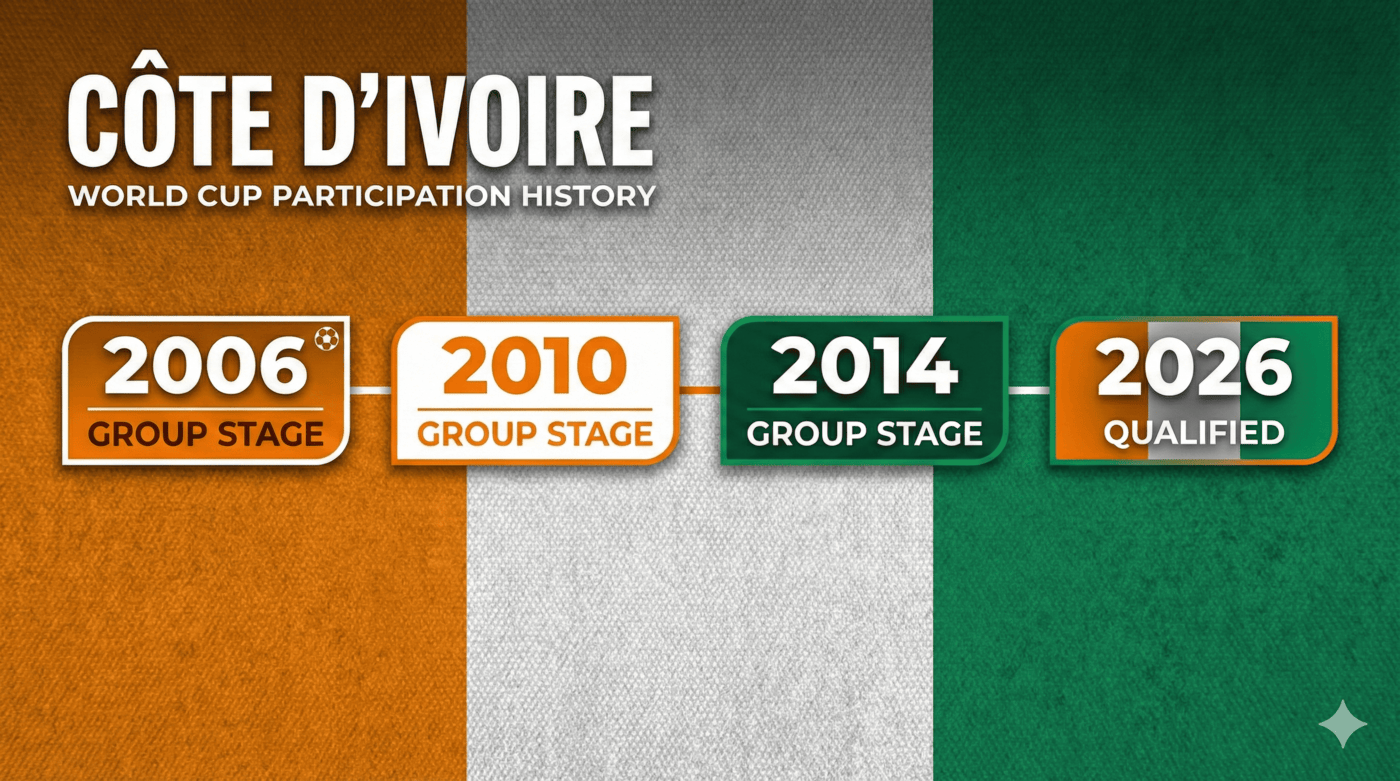
🇨🇮🐘 Ivory Coast, the quiet giant that never blinked
A flawless CAF campaign, a defense untouched, and a World Cup group that asks for maturity more than magic.
Introduction
There are qualifying runs that feel like a storm: loud, chaotic, carried by surges and improvisation. Ivory Coast’s road was the opposite. It read like a metronome. Match after match, the same pulse: control the risk, strike when the moment opens, and keep the back door bolted shut.
It began with a scoreline that doesn’t need adjectives. On 17 November 2023, at the Stade Olympique Ebimpé, Seychelles were swallowed whole: 9–0. The kind of opener that can intoxicate a squad if it becomes the only reference point. Ivory Coast treated it as a statement, then immediately returned to more serious work.
Because the real signature of this team wasn’t the nine. It was the zero. Ten games, 0 goals conceded. Not one wobble that became damage. That single number, repeated week after week, is what turns a good group into a locked one.
The table confirms the story with no need for embellishment: first place in Group F, 26 points from 10 matches, unbeaten, 25 goals scored and 0 conceded, +25 goal difference. They edged Gabon by a single point, which matters because it tells you something important: this wasn’t a stroll with nobody chasing. It was a race decided by detail.
The turning points are easy to locate because they were small, tense, and revealing. On 7 June 2024, Ivory Coast beat Gabon 1–0, a direct duel managed with the seriousness of a final. Four days later, 11 June 2024, a 0–0 away to Kenya—no fireworks, just the ability to leave with something and keep the line intact. Then, late in the cycle, the 0–0 in Franceville against Gabon on 9 September 2025 felt like a test of nerves: a match where conceding would have rewritten the entire group dynamic.
The last image of the campaign was the most symbolic. On 14 October 2025, at the Stade Alassane Ouattara, they finished Kenya 3–0. Not because they needed to prove anything, but because this team’s habit is to close doors properly, not with half measures.
The Road Through Qualifiers
CAF qualification for the 2026 World Cup was a marathon dressed as a league: a group phase in which teams played home-and-away round robin matches, and the group winners qualified directly. The format rewards consistency more than peak performance. It also punishes “almost”: finishing second can still leave you stranded depending on the broader comparison among runners-up. In that context, Ivory Coast’s approach makes perfect sense: minimize the room for randomness.
Group F, on paper, offered variety rather than glamour: Gabon as the main competitor, Kenya as a physical and unpredictable away trip, Gambia capable of scoring in bursts, Burundi with stubborn games, and Seychelles as the clear underdog. The standings ended up confirming the expected hierarchy at the top, but not the margin: Ivory Coast won the group by one point over Gabon, which means every draw mattered, every narrow win mattered, every clean sheet mattered.
The campaign’s rhythm can be split into phases. Phase one: explosive start and quick authority. The 9–0 over Seychelles on 17 November 2023 was followed by a controlled 2–0 away win against Gambia on 20 November 2023 at the National Stadium in Dar es-Salaam. Two games, 11 scored, 0 conceded: the message was clear, but the real value was psychological. Early points reduce desperation later.
Phase two: the “tight margin” stretch. On 7 June 2024, they beat Gabon 1–0 at the Stade Amadou Gon Coulibaly. On 11 June 2024, they drew 0–0 away to Kenya at the Bingu National Stadium. It was a week that showed two faces: the ability to win the key match, and the discipline to accept a draw without losing structure. That’s a qualifier’s skill, not a highlight reel.
Phase three: the professional closure. In 2025, Ivory Coast stacked short wins that are deceptively hard: 1–0 away to Burundi on 21 March 2025, 1–0 home to Gambia on 24 March 2025, 1–0 home to Burundi on 5 September 2025. Then came the two big punctuation marks: 0–0 away to Gabon on 9 September 2025, and the double finish of 7–0 away to Seychelles on 10 October 2025 plus 3–0 at home to Kenya on 14 October 2025. When a team can win ugly, then win loud, it means the base is stable.
Now the numbers that define the logic. Ten matches: 8 wins, 2 draws, 0 losses. Goals for: 25. Goals against: 0. The offensive total is impressive, but it’s not “all gas”: they scored 9 in one match and 7 in another, meaning 16 of 25 goals came in the two games against Seychelles. That’s not a criticism; it’s a reminder that their day-to-day edge was built on narrow margins: they won five matches 1–0.
That profile is exactly what keeps you alive in qualifying. The group was decided by one point, and Ivory Coast collected two draws—both 0–0—without paying the usual price. No late concession, no freak set-piece, no “we deserved more.” Just clean math.
Table 1: All Ivory Coast matches in CAF Group F
| Date | Group | Matchday | Opponent | Venue status | Score | Goalscorers | Stadium |
|---|---|---|---|---|---|---|---|
| 17 November 2023 | F | 1 | Seychelles | Home | 9–0 | Haller 20' pen., Sangaré 24', Adingra 36', Konaté 40', 90+5', S. Fofana 60', Traorè 77', 90+4', Krasso 84' pen. | Stade Olympique Ebimpé |
| 20 November 2023 | F | 2 | Gambia | Away | 2–0 | Kouamé 45', S. Fofana 85' | National Stadium Dar es-Salaam |
| 7 June 2024 | F | 3 | Gabon | Home | 1–0 | Fofana 36' | Stade Amadou Gon Coulibaly |
| 11 June 2024 | F | 4 | Kenya | Away | 0–0 | Bingu National Stadium | |
| 21 March 2025 | F | 5 | Burundi | Away | 1–0 | Guessand 16' | Stade d'Honneur Mequinez |
| 24 March 2025 | F | 6 | Gambia | Home | 1–0 | Haller 15' | Stade Félix Houphouët-Boigny |
| 5 September 2025 | F | 7 | Burundi | Home | 1–0 | Bayo 3' | Stade Félix Houphouët-Boigny |
| 9 September 2025 | F | 8 | Gabon | Away | 0–0 | Stade de Franceville | |
| 10 October 2025 | F | 9 | Seychelles | Away | 7–0 | Sangaré 7' pen., Agbadou 17', Diakité 32', Guessand 39', Diomande 55', Adingra 67', Kessié 90' | Côte d'Or National Sports Complex |
| 14 October 2025 | F | 10 | Kenya | Home | 3–0 | Kessié 7', Diomande 54', Diallo 84' | Stade Alassane Ouattara |
The table context matters because it shows how thin the margin was at the top, and how safe it never felt. Gabon finished with 25 points—one less—with 22 scored and 9 conceded. That’s the chase: productive, but leaky. Ivory Coast didn’t beat Gabon by outscoring them; they beat them by refusing to concede, and by winning their own “small” games.
Table 2: Group F standings
| Position | Team | Points | Played | Wins | Draws | Losses | Goals for | Goals against | Goal difference |
|---|---|---|---|---|---|---|---|---|---|
| 1 | Ivory Coast | 26 | 10 | 8 | 2 | 0 | 25 | 0 | +25 |
| 2 | Gabon | 25 | 10 | 8 | 1 | 1 | 22 | 9 | +13 |
| 3 | Gambia | 13 | 10 | 4 | 1 | 5 | 27 | 18 | +9 |
| 4 | Kenya | 12 | 10 | 3 | 3 | 4 | 18 | 14 | +4 |
| 5 | Burundi | 10 | 10 | 3 | 1 | 6 | 13 | 13 | 0 |
| 6 | Seychelles | 0 | 10 | 0 | 0 | 10 | 2 | 53 | −51 |
A few performance splits bring the story into sharper focus:
- Home matches: 5 played, 5 wins, 15 goals scored, 0 conceded. That’s perfect output with a clear attacking ceiling at home.
- Away matches: 5 played, 3 wins and 2 draws, 10 goals scored, 0 conceded. The important part is not the goals scored; it’s that they didn’t lose away, and they didn’t concede away.
- One-goal wins: five separate 1–0 results (vs Gabon, vs Burundi twice, vs Gambia, plus another 1–0 at home vs Gambia). That’s not accident; that’s a team built to survive the low-scoring game.
- Draws: exactly two, both 0–0 (away vs Kenya; away vs Gabon). When they didn’t win, they still didn’t bleed.
In CAF qualifying, where pitches, travel, and match tempo change dramatically from window to window, that’s a competitive advantage: you don’t need the match to look pretty to make it useful.
How they play
The identity is readable from the scorelines: Ivory Coast plays to protect the match first, and then decides how big the win can become. Ten matches, zero conceded is not just a defensive stat; it’s a strategic choice. When a team never concedes, the opponent’s plan collapses early: you can’t lure them into a shootout, you can’t punish their risk, you can’t buy time with an away goal. You have to beat them clean. Nobody did.
In practical terms, this Ivory Coast has shown it can live inside tight margins without panic. Five 1–0 wins are the smoking gun. A team that relies on chaos usually turns those games into 2–2s or 3–2s. Here, they stayed at 1–0 and made it stand. That suggests controlled risk: after scoring, the priority becomes game management rather than chasing a second at all costs. It’s the profile of a side that trusts its structure.
The rhythm of the campaign also reveals an important duality: the team can accelerate massively when the conditions allow it. Two matches produced 16 goals: 9–0 and 7–0 against Seychelles. That doesn’t mean “Ivory Coast always attacks like this.” It means the team is capable of turning superiority into punishment. Some national teams dominate and still win 2–0. This one, when the opponent breaks, doesn’t stop at the polite margin.
Goal distribution hints at variety. Across the listed goalscorers, names repeat but do not monopolize: S. Fofana scores in multiple matches; Haller appears with penalties and a key 1–0; Kessié closes the campaign with goals; Sangaré, Adingra, Guessand, Diomande, Diallo, Bayo, Kouamé, Krasso, Konaté, Agbadou, Diakité, Traorè all appear. Even allowing for the Seychelles effect, the scoring sheet reads like a roster, not a dependency.
That matters for tournament football. When only one name carries the goals, one off day or one tight marking plan can collapse your attack. Here, the evidence suggests multiple routes to scoring: early goals (Bayo at 3', Haller at 15', Kessié at 7'), late insurance (S. Fofana at 85', added-time goals in the 9–0), and scoring away from home (Gambia 0–2; Burundi 0–1; Seychelles 0–7). The team doesn’t need the same script every time.
The vulnerabilities, from the same evidence, live mostly in creation rather than protection. Two 0–0 draws away (Kenya and Gabon) show that in certain environments—away trips against organized opponents—Ivory Coast can be held scoreless. The key point is that they still walked out with the clean sheet. But in a World Cup group, a 0–0 can be useful or costly depending on the other results. Their challenge is not “how to defend.” It’s how to turn control into at least one goal when the opponent’s resistance holds.
If you want one final numeric distillation: 10 matches played, 7 clean-sheet wins, 2 clean-sheet draws, 1 clean-sheet win with a huge scoreline? Not exactly—every single match is a clean sheet. That is extreme. Maintaining that against higher-level opponents is difficult, but the underlying habit—minimizing concession events—tends to travel well.
The Group at the World Cup
Group E gives Ivory Coast a test with three very different textures: Ecuador, Germany, and Curaçao. Three opponents, three game types. And three venues that shift the feel of the tournament: Houston, Toronto, Philadelphia. That is a travel-and-recovery mini-campaign inside the campaign.
The opener matters most because it sets the emotional volume of the group. Ivory Coast begin on 14 June 2026 against Ecuador at NRG Stadium in Houston. Opening games often punish teams that arrive with big ideas and loose details. Ivory Coast arrive with the opposite: details first. That can be an advantage in match one, when legs are heavy and clarity is scarce.
Then comes the headline fixture: Germany vs Ivory Coast on 20 June 2026 at BMO Field in Toronto. Regardless of what Germany look like by then, the match will likely be framed as the “control vs. initiative” duel. Ivory Coast’s qualifying evidence suggests they can accept a game where chances are rationed. The question becomes whether they can create enough to threaten without exposing the one thing they protected perfectly in qualifying: the clean sheet.
Finally, on 25 June 2026, Curaçao vs Ivory Coast at Lincoln Financial Field in Philadelphia. Third group matches often turn into math. They can be frantic, cautious, or both within the same ninety minutes. Ivory Coast’s qualifying run suggests they handle “math games” well: they won narrow, they drew away, they didn’t chase chaos. That temperament is valuable when a point is worth more than aesthetics.
World Cup Group E fixtures for Ivory Coast
| Date | Stadium | City | Opponent |
|---|---|---|---|
| 14 June 2026 | NRG Stadium | Houston | Ecuador |
| 20 June 2026 | BMO Field | Toronto | Germany |
| 25 June 2026 | Lincoln Financial Field | Philadelphia | Curaçao |
Match-by-match, a probable script and a plain prediction:
-
Ivory Coast vs Ecuador Script: a match that tests patience. Ivory Coast’s qualifying trend points to controlled starts and a willingness to win 1–0 rather than win beautifully. If they can score first, their favorite territory opens: managing the game without donating transitions. Prediction: draw.
-
Germany vs Ivory Coast Script: a game where Ivory Coast’s defensive record becomes both shield and temptation. The risk is obvious: sit too deep and invite volume; push too high and break the compactness that defined qualifying. The best version is a disciplined mid-block with selective attacks, aiming to keep the scoreline within one goal either way. Prediction: Germany wins.
-
Curaçao vs Ivory Coast Script: a match for imposing conditions. Not because the opponent should be labeled, but because Ivory Coast’s numbers show they thrive when they can set the terms early: score first, then tighten. If qualification depends on points here, the campaign suggests they can be ruthless without losing order. Prediction: Ivory Coast wins.
Keys to qualification for Ivory Coast in Group E
- Turn the opener into a points game: avoid conceding first, and keep the match inside a one-goal margin where they’ve been elite.
- Treat the Germany match as a damage-control opportunity without surrendering all ambition: even a narrow loss can be manageable if goal difference stays clean.
- Arrive at match three with clarity: their qualifying profile fits scenarios where a win is needed but risk must be rationed.
- Keep the first goal as a weapon: their clean sheets and multiple 1–0 wins suggest scoring first changes the match’s gravity.
Editorial opinion
Ivory Coast qualified like a team that knows what it is and doesn’t apologize for it. The campaign was not built on constant spectacle; it was built on repeatable behaviors: concede nothing, accept narrow wins, and strike hard when the opponent collapses. That is not romantic football. It is tournament football. And in a World Cup group, tournament football ages well.
The temptation will be to demand “more” because the badge carries talent and history. But the evidence from this run says something sharper: the superpower was not flair, it was discipline. The moment Ivory Coast start chasing identity in the wrong direction—opening games unnecessarily, trading punches for pride—they risk losing the one edge that made the group phase feel inevitable.
The warning is concrete and it lives inside their own best habits. Look at 11 June 2024 in Kenya: 0–0 away, no goals, no collapse. That match is the blueprint for surviving when the attack stalls. If, at the World Cup, an early game starts to resemble that kind of stalemate, Ivory Coast must resist the urge to overcorrect. Their path was written by staying calm when nothing was happening—and then letting the first good moment be enough.