
Algeria - Grupo J
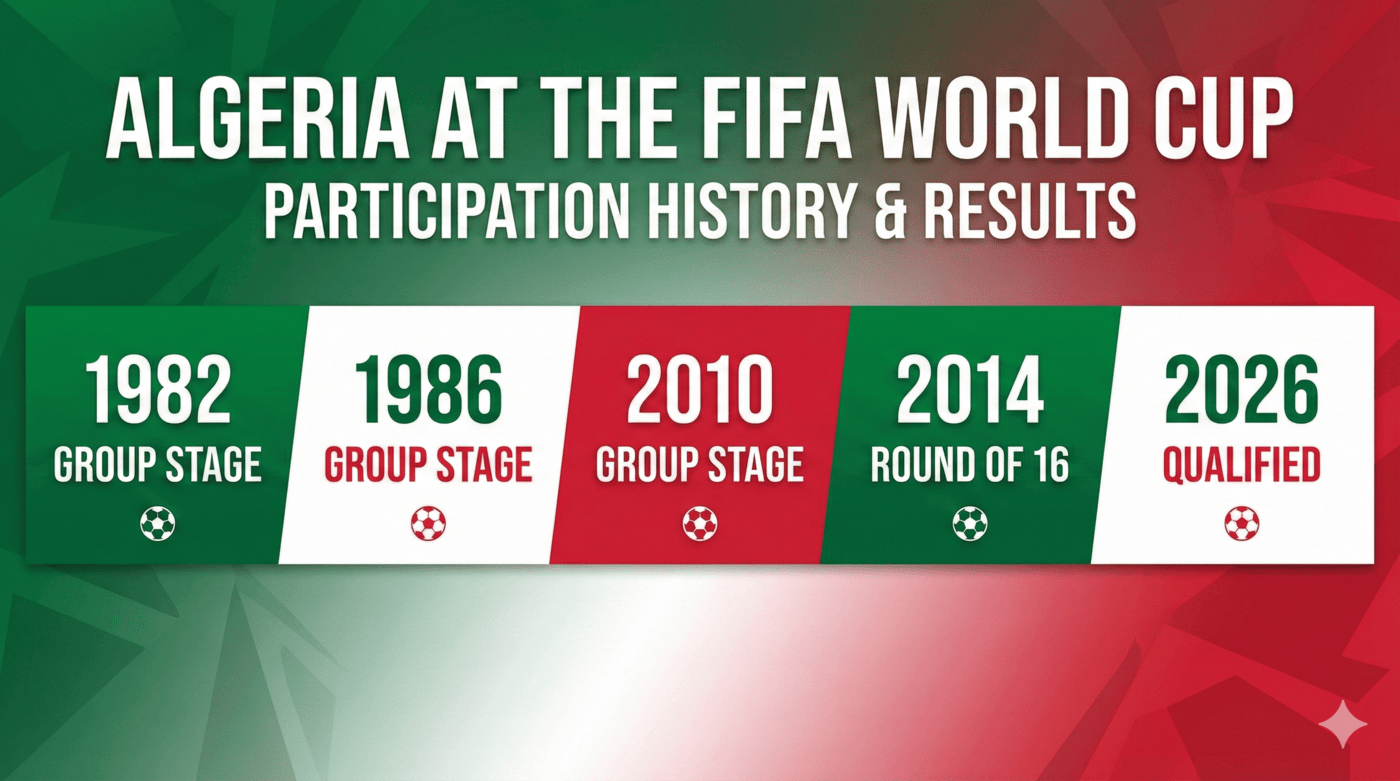
🇩🇿🦊 Algeria arrive with teeth bared
A qualification run built on road wins, late punches, and a striker in full blaze.
Introduction
There are teams that qualify by paperwork and probability, and there are teams that qualify by leaving marks on the calendar. Algeria’s route belongs to the second group: games that start orderly and finish loud, away trips handled with the coldness of a veteran, and home nights where the scoreline expands like a story that refuses to end at 1–0. The numbers are neat, but the sequence is even better: a campaign with rhythm, bite, and a recurring signature—pressure that doesn’t always look frantic, but keeps returning until the opponent breaks.
This Algeria does not sell mystery. It sells repetition. The same match plot keeps appearing with small variations: take control early, accept that a moment of discomfort will come, and then decide the outcome with two actions—sometimes two goals—in a short window. When the game stays tight, they have a late answer. When the opponent opens up, they turn the match into a runway for the forwards. That mix—patience plus a second gear—gave them a qualification story that reads like a controlled burn.
The table frames it without poetry: Algeria finished first in Group G with 25 points from 10 matches, eight wins, one draw, one loss, and a goal difference of +16. They scored 24 and conceded 8. In a group where second place reached 18 points, Algeria didn’t merely edge it; they created air. Their defensive record is not sterile—there were goals conceded, and a couple of games with nerves—but across ten matchdays, they allowed fewer than a goal per game and generated nearly two and a half at the other end.
Three hinge moments tell the arc. On 6 June 2024, a home loss to Guinea (1–2) punctured any illusion of a cruise; it was a match where Algeria scored via an own goal and still couldn’t rescue the points. On 25 March 2025, they responded with a statement: 5–1 at home against Mozambique, the kind of scoreline that doesn’t just earn three points—it rearranges a group’s mood. And on 14 October 2025, they sealed the campaign’s emotional thumbnail: 2–1 at home against Uganda, both Algeria goals coming from penalties in the 81st and 90+9th minutes. That wasn’t just winning; that was refusing to negotiate.
There is also a quieter hinge that matters: the away wins that kept the table clean. Mozambique away (0–2), Uganda away (1–2), Botswana away (1–3), Somalia away (0–3). These aren’t glamorous trips in the football imagination, but qualification is often decided there: in the ability to keep the match short, deny chaos, and convert control into goals. Algeria did that repeatedly, and by the end, Group G looked less like a traffic jam and more like a ladder with one team several steps above the rest.
The Road Through Qualifiers
CAF qualifying for the World Cup is a marathon disguised as a series of sprints: group games where dropping points early can complicate everything, but the true elite usually separate themselves by doing the boring things well—winning away, avoiding multi-goal concessions, and inflating the goal difference when the chance appears. Algeria’s Group G campaign fits that profile: a steady accumulation that only briefly wobbled, followed by a surge that turned “favourites” into “unavoidable”.
Start with the table and the gap. Algeria: 25 points, Uganda: 18, Mozambique: 18, Guinea: 15, Botswana: 10, Somalia: 1. The symmetry is interesting: Uganda and Mozambique tied on points, yet Mozambique finished with a negative goal difference (14 scored, 17 conceded). Algeria weren’t just winners; they were efficient winners. Their +16 dwarfs Uganda’s +5 and Guinea’s +3. Over ten games, that’s the difference between “qualified” and “qualified early in spirit”.
The campaign begins cleanly at home on 16 November 2023: Algeria 3–1 Somalia. It’s a match that hints at two recurring themes. First, scoring variety and opportunism—an own goal opened the account at 2', then Baghdad Bounedjah and Islam Slimani added separation. Second, the concession: Somalia scored on 65'. Algeria could win comfortably without keeping a clean sheet, because their scoring capacity created margin.
Three days later, the away win at Mozambique (19 November 2023, 0–2) was the first proof that this would not be a home-only qualification. Two late goals—69' and 80'—suggest a team that doesn’t panic if the game is level past the hour. That’s a pattern that returns: Algeria often strike after halftime, and often twice, which is the most demoralizing rhythm for opponents who think they’ve survived the first wave.
Then came the one match that threatens to become a scar if you let it: 6 June 2024, Algeria 1–2 Guinea. The scoring summary is unusual: Algeria’s goal comes from an own goal at 52', while Guinea score at 50' and 63'. In practical terms, that means Algeria were chasing the match from just after halftime and never fully found the equalizer. If you want to understand their campaign’s psychology, start here: the only defeat arrives at home, in a game decided by two second-half punches.
The immediate response was the kind a group leader needs. On 10 June 2024, Algeria went to Uganda and won 1–2. Conceding at 10' could have been a trap, a narrative device for the home side. Instead Algeria flipped it after the break—46' and 58'. That tells you something about their halftime adjustments without needing to invent tactical diagrams: whatever happens in the first 45 minutes, Algeria have shown an ability to return from the dressing room with a sharper edge.
The 2025 window is where the campaign turns from “good” to “dominant.” On 21 March 2025, Algeria won 1–3 away at Botswana, with goals at 44' and then a two-goal burst from 52' to 74'. Four days later, the home demolition of Mozambique (5–1) turned the group into a scoreboard exercise. Mohamed Amoura scored three times (8', 30', 80'), Aïssa Mandi added a goal at 24', and Jaouen Hadjam at 65'. In one night, Algeria didn’t just beat a direct rival—they widened the margin so that even a later stumble wouldn’t immediately endanger first place.
By September 2025, the campaign was almost in closing mode, yet Algeria still played with the urgency of a team that wanted to remove doubt. On 4 September: Algeria 3–1 Botswana. On 8 September: Guinea 0–0 Algeria, a scoreline that matters because it shows Algeria can also accept a point in a difficult away context without forcing the match into a risk festival. Then October brought the final two stamps: Somalia 0–3 Algeria on 9 October, and Algeria 2–1 Uganda on 14 October, the latter won with two penalties in the last ten minutes plus stoppage. That finish is a personality: calm enough to wait, ruthless enough to strike when the opponent’s legs and discipline start to fray.
Below is the complete set of Algeria’s qualifying matches from the provided data.
| Date | Group | Matchday | Opponent | Venue status | Result | Goal scorers | Stadium |
|---|---|---|---|---|---|---|---|
| 16 November 2023 | G | 1 | Somalia | Home | 3:1 | Abdi 2' (o.g.), Bounedjah 31', Slimani 80'; Ahmed 65' | Nelson Mandela Stadium |
| 19 November 2023 | G | 2 | Mozambique | Away | 0:2 | Chaïbi 69', Zerrouki 80' | Stadium do Zimpeto |
| 6 June 2024 | G | 3 | Guinea | Home | 1:2 | Baldé 52' (o.g.); M. Sylla 50', A. Camara 63' | Nelson Mandela Stadium |
| 10 June 2024 | G | 4 | Uganda | Away | 1:2 | Mutyaba 10'; Aouar 46', Benrahma 58' | Nelson Mandela National Stadium |
| 21 March 2025 | G | 5 | Botswana | Away | 1:3 | Kopelang 70'; Gouiri 44', Amoura 52', 74' | Obed Itani Chilume Stadium |
| 25 March 2025 | G | 6 | Mozambique | Home | 5:1 | Amoura 8', 30', 80', Mandi 24', Hadjam 65'; Catamo 40' | Hocine-Aït-Ahmed Stadium |
| 4 September 2025 | G | 7 | Botswana | Home | 3:1 | Amoura 33', Bounedjah 71', 90+6'; Kopelang 43' | Hocine-Aït-Ahmed Stadium |
| 8 September 2025 | G | 8 | Guinea | Away | 0:0 | Mohammed V Stadium (Casablanca) | |
| 9 October 2025 | G | 9 | Somalia | Away | 0:3 | Amoura 7', 57', Mahrez 19' | Miloud Hadefi Stadium |
| 14 October 2025 | G | 10 | Uganda | Home | 2:1 | Amoura 81' (pen.), 90+9' (pen.); Mukwala 6' | Hocine-Aït-Ahmed Stadium |
Now the standings, complete and uncut, exactly as the data presents them. There is only one table in STANDINGS_TABLE, corresponding to Group G, and Algeria appear in it as leaders.
Table 1 — Group G standings
| Pos | Team | Pts | Played | W | D | L | GF | GA | GD |
|---|---|---|---|---|---|---|---|---|---|
| 1 | Algeria | 25 | 10 | 8 | 1 | 1 | 24 | 8 | +16 |
| 2 | Uganda | 18 | 10 | 6 | 0 | 4 | 14 | 9 | +5 |
| 3 | Mozambique | 18 | 10 | 6 | 0 | 4 | 14 | 17 | −3 |
| 4 | Guinea | 15 | 10 | 4 | 3 | 3 | 11 | 8 | +3 |
| 5 | Botswana | 10 | 10 | 3 | 1 | 6 | 12 | 16 | −4 |
| 6 | Somalia | 1 | 10 | 0 | 1 | 9 | 3 | 20 | −17 |
From this table, a few performance splits emerge without guesswork:
-
Home output: 5 home matches, 14 goals scored, 6 conceded. The “6 conceded” is the little warning sign: even dominant campaigns can carry moments of looseness at home, especially when the game opens.
-
Away control: 5 away matches, 10 goals scored, only 2 conceded. That is the backbone statistic. Algeria’s qualification was not built exclusively on high-scoring nights; it was built on travel discipline.
-
One-goal games: there were four matches decided by a single goal (3–1 not included; 1–2, 1–2, 2–1, plus arguably tight phases in others). In those, Algeria took points in three of four—two away wins and the late home win over Uganda—while the only loss of the campaign was also by one goal. This suggests their floor level is strong: even when they don’t dominate, they stay close.
-
Momentum: after the home loss to Guinea, Algeria never lost again in the provided matches. The run includes the 0–0 away at Guinea, which is the kind of result that often seals group leadership—not because it is beautiful, but because it denies a rival the oxygen of a win.
How they play
Algeria’s identity in these numbers is clear: they are a team that can win in multiple temperatures. When the game is open, they can score three, even five. When the game is tense and stingy, they can win late or settle for a draw away without turning it into a gamble. That flexibility is not a tactical diagram; it is an outcome pattern repeated over ten matchdays.
The first major trend is second-half authority. In several key matches, Algeria’s decisive goals arrive after the break: at Mozambique (69', 80'), at Uganda (46', 58'), at Botswana away (52', 74'), against Botswana at home (71', 90+6'), at Somalia (57'), and the double-penalty finish against Uganda (81', 90+9'). Even the 5–1 over Mozambique includes an 80' goal to close the story. This does not automatically mean “fitness” or a specific pressing scheme—but it does mean Algeria keep their attacking relevance alive deep into matches, and opponents have repeatedly cracked late.
The second trend is a striker-driven peak with support. Mohamed Amoura is the headline: hat-trick against Mozambique, brace away at Botswana, decisive late penalties against Uganda, brace plus stoppage-time goal involvement across multiple games, and goals against Somalia (twice) with an early strike at 7' as well. In the ten matches, his name appears across a wide range of minutes: early (7', 8'), mid (52', 57'), late (80', 81', 90+6', 90+9'). That minute distribution matters: it suggests Algeria can threaten at kickoff, immediately after halftime, and in the last breath.
But it’s not a one-man show. There are goals from Bounedjah, Slimani, Mahrez, Aouar, Benrahma, Gouiri, Zerrouki, Chaïbi, Mandi, Hadjam—and even an own goal that opened a match. That spread is important because in tournament football, dependence is always a risk. Algeria have a focal scorer, yes, but the supporting cast has already turned up in meaningful moments: Benrahma and Aouar for a comeback win away at Uganda; Mahrez in an away win; defenders contributing in a 5–1.
Defensively, the numbers show a specific strength: away match management. Two goals conceded in five away matches is elite-level control by any qualifying standard. The opponent can score first—Uganda did at 10'—and Algeria can still restore order. They also kept clean sheets away at Mozambique, Guinea, and Somalia. This combination hints at a team comfortable without the ball in phases, or at least comfortable defending its box and limiting high-quality chances, even if we cannot assign a specific tactical shape from the dataset.
The vulnerability is equally visible: home concessions and the Guinea problem. Algeria conceded in four of five home matches, including the only defeat of the campaign (1–2 against Guinea) and a match where they needed two late penalties to beat Uganda. If you’re looking for the “tournament caution,” it is here: against organized opponents who can survive early pressure and strike in transition, Algeria have shown they can be made uncomfortable—especially at home, where matches sometimes become emotionally louder and tactically looser. The solution in the numbers is not “play prettier,” but “stay patient and avoid the single lapse that forces a chase.”
The Group at the World Cup
Group J offers Algeria a narrative-ready trio of opponents: Argentina, Jordan, and Austria. It is a group with contrasting match textures on paper—one opponent associated with controlling the ball and punishing errors, one that can turn games into stubborn trench fights, and one that often brings physical rhythm and transitions. But since we are not using external datasets for rivals, the most honest way to preview it is through Algeria’s own tendencies: how they handle favourites, how they handle matches they must win, and how they handle the swing game that decides the table.
The opening match is immediately a temperature test: Argentina vs Algeria on 16 June 2026 at Arrowhead Stadium in Kansas City. For Algeria, the key from qualifying is not to chase too early. Their best games come when they can keep the match within reach and then strike in decisive windows. Against a high-calibre opponent, those windows might be fewer, so Algeria’s priority is to stay in the game long enough for the second-half pattern to matter.
The second match—Jordan vs Algeria on 22 June 2026 at Levi’s Stadium in San Francisco—reads like the group’s hinge. This is the kind of game where qualification campaigns can deceive: a team can look brilliant against the top seed and still fail if it cannot turn the “must not drop points” match into a win. Algeria’s away record in qualifying is the reassurance: five away matches, four wins, one draw, 10 scored, 2 conceded. They have shown they can travel and still impose an outcome. If Algeria want to qualify from Group J, this match is the one where efficiency matters more than aesthetics.
The closer is Algeria vs Austria on 27 June 2026 back at Arrowhead Stadium in Kansas City. Group-stage finales are rarely clean: the table dictates the emotions, and the emotions dictate the decisions. Algeria have already played a match that resembles a “final day” scenario in terms of pressure: the 2–1 vs Uganda on 14 October 2025, won with penalties at 81' and 90+9'. That game suggests Algeria can keep their nerve late. The danger, as always, is conceding first and turning the match into a chase with a ticking clock.
Here is the full schedule of Algeria’s three group matches, as provided:
| Date | Stadium | City | Opponent |
|---|---|---|---|
| 16 June 2026 | Arrowhead Stadium | Kansas City | Argentina |
| 22 June 2026 | Levi's Stadium | San Francisco | Jordan |
| 27 June 2026 | Arrowhead Stadium | Kansas City | Austria |
A match-by-match, plain-language forecast—kept deliberately grounded in Algeria’s own evidence:
-
Argentina vs Algeria: Argentina win. Algeria’s route shows they can stay alive in games and strike late, but against the highest-level opponent, the margin for error shrinks. The best Algerian version here is the away version: low concessions, high patience.
-
Jordan vs Algeria: Algeria win. If Algeria reproduce the away profile—concede little, score in the second half—they have the tools to make this the match where points become momentum.
-
Algeria vs Austria: Draw. Algeria’s tournament logic often points to a tight finish: they’ve shown they can win late, but also that home games can get messy if the opponent scores first. A draw feels like the most reasonable “table-aware” outcome without importing rival data.
Keys to qualification for Algeria, distilled from the qualifying campaign:
- Keep the away-match discipline: the “2 conceded in 5 away games” profile is the blueprint.
- Avoid early concessions that force a chase; the only defeat began with second-half goals conceded in quick sequence.
- Lean into second-half influence: many decisive goals arrived after halftime and late.
- Maintain scoring support around the main finisher; Algeria’s goal spread is a quiet advantage in short tournaments.
- Treat the middle match like a final: Algeria’s best campaigns are built on not dropping the “should-win” points.
Editorial opinion
Algeria’s qualification wasn’t a romantic surprise; it was a professional job done with sharp tools. The table says “first place,” but the match list says something stronger: a team that learned from its only loss and never repeated it. The away numbers are the calling card—10 goals scored, 2 conceded in five away games—and that is the kind of profile that travels well into a World Cup, where not every match will be played on your terms.
The seduction, though, is to assume that a team who can score five at home will always have an easy solution. The campaign itself warns against that. At home, Algeria conceded six in five matches and needed two late penalties to beat Uganda. That is not a flaw; it is a reality: when the game becomes anxious, when control turns into hurry, the opponent gets invited into the match. The World Cup punishes invitations.
The last image to keep in mind is not the 5–1 celebration, but the 14 October 2025 finish against Uganda: two penalties, late, after conceding first. It’s a beautiful survival skill, but it is also a gamble you don’t want to repeat too often on the biggest stage. Algeria have the firepower and the travelling discipline to write a strong group story. The warning is simple and concrete: don’t spend an hour trying to “deserve” a goal—because sometimes, as the 6 June 2024 loss to Guinea proved, football doesn’t pay back dominance with interest.