



Cabo Verde - Grupo H
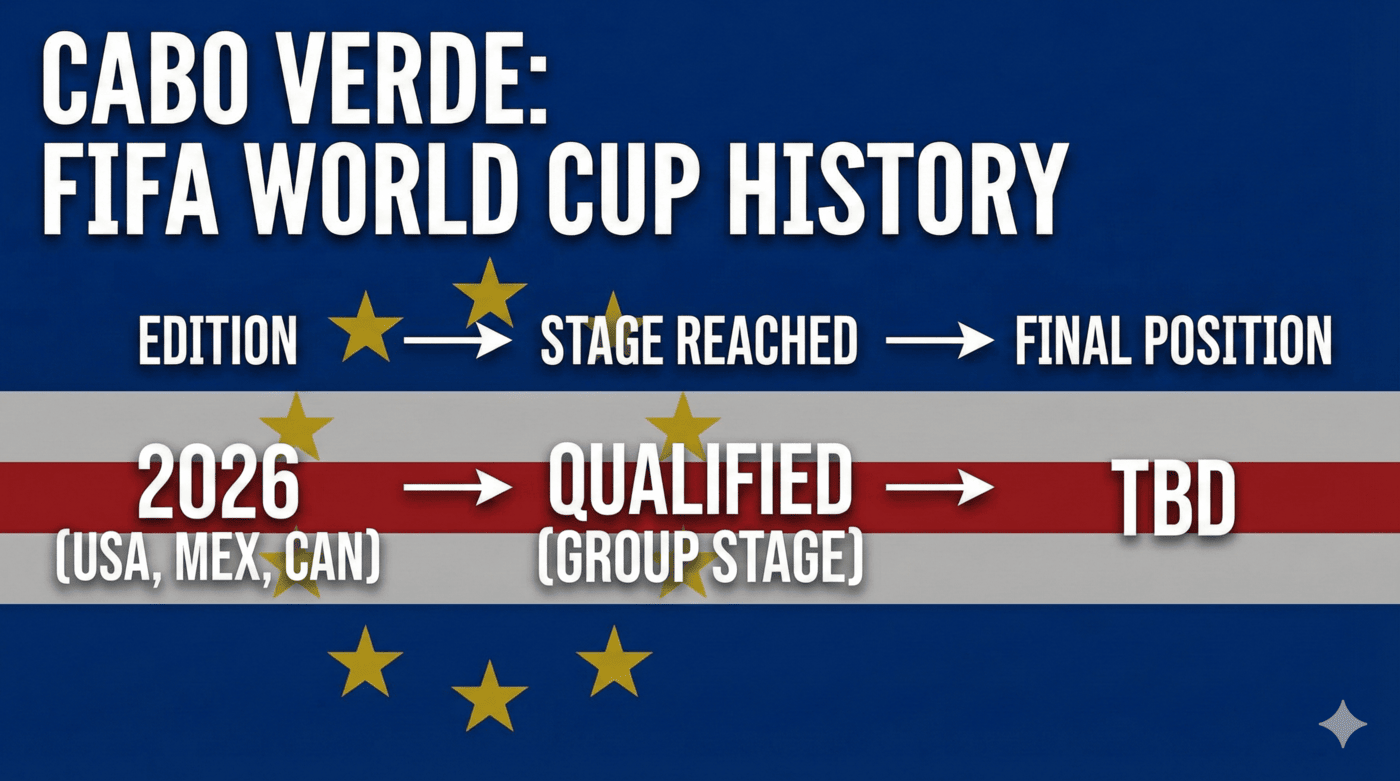
🇨🇻🔥 Cape Verde crash the party: the Blue Sharks swim into World Cup waters
A qualifying run built on clean margins, clutch goals, and the kind of away-day nerve that turns a small nation into a very real problem.
Introduction
There are teams that qualify by making noise. And there are teams that qualify by making you look up at the scoreboard, again and again, and realizing—quietly, stubbornly—that the same name keeps showing up on top. Cape Verde’s route had more of the second kind: less fireworks, more steel. A campaign that felt like a long tide coming in, one controlled wave at a time, until the table could no longer pretend it was a surprise.
The story begins in Praia, with a 0–0 against Angola on 16 November 2023. A goalless opener can be a warning sign; here, it read like a promise: we will not gift you anything. Five days later, in Mbombela, the message got bolder—Eswatini 0–2 Cape Verde on 21 November 2023—Mendes at 17’, Monteiro at 38’. Two punches, early enough to shape the game, calm enough to avoid chaos.
Then came the one night that could have cracked the narrative: 8 June 2024, Yaoundé. Cameroon 4–1 Cape Verde. A heavy scoreline, the kind that tests whether a team’s belief is real or just a good month. Cape Verde’s response wasn’t poetic—it was practical. Three days later, back in Praia, they beat Libya 1–0 (11 June 2024), Diney scoring at 10’. The campaign didn’t drift. It snapped back into shape.
By the end of Matchday 10, Cape Verde stood first in Group D with 23 points from 10 matches: 7 wins, 2 draws, 1 loss. They scored 16 and conceded 8, for a +8 goal difference. The numbers aren’t inflated by one freak afternoon; they’re the product of a consistent pattern: win the tight ones, manage the margins, and keep the opponent’s best periods from becoming goals.
Two moments, in particular, felt like hinges rather than highlights. One was 25 March 2025 in Luanda: Angola 1–2 Cape Verde, with Livramento scoring twice (45+2’ and 63’) to turn a dangerous away match into a statement. The other was 9 September 2025 in Praia: Cape Verde 1–0 Cameroon, Livramento again at 54’. Not revenge—something more useful than that. Proof that the 4–1 in Yaoundé had not defined them.
And if the campaign had a signature finale, it was the 13 October 2025 home win over Eswatini: 3–0, with goals from Livramento (48’), W. Semedo (54’) and Stopíra (90+1’). Not just three points—three different timestamps, three different types of pressure managed, and the kind of scoreline that makes a group title feel earned rather than borrowed.
The Road Through Qualifiers
CAF qualifying for the 2026 FIFA World Cup followed a clear path: nine groups of six teams, home-and-away round robin. Each group winner qualifies directly; beyond that, the best runners-up across groups move into a continental play-off that can still open a door through the intercontinental route. In Group D, Cape Verde didn’t ask for extra doors. They walked through the main one.
Group D was not a gentle neighborhood. Cameroon’s numbers tell you that: 17 goals scored, only 5 conceded, +12 goal difference. Libya stayed competitive with 16 points and a positive differential. Angola drew a lot and rarely collapsed. Yet Cape Verde did what champions do in these groups: they turned “competitive” into “not enough,” and they did it with a campaign that traveled well.
The table makes Cape Verde’s advantage look slim in one way and large in another. Slim because Cameroon finished on 19 points—four behind, close enough to keep pressure alive. Large because Cape Verde only lost once in 10 matches. In a format where a bad week can become a bad year, that is the difference between being chased and being caught.
There’s also a quiet irony in their goal numbers: Cape Verde scored 16, Cameroon scored 17, yet Cape Verde topped the group. That’s the profile of a team that doesn’t need to “win the xG debate” in public; it needs to win the points debate in private. Concede eight across ten matches, and you’re allowed to win with 1–0s, late goals, and the occasional controlled burst.
That pattern shows up early. The opening 0–0 against Angola could have been a missed chance, but it set a defensive baseline. Then came the first away win in Eswatini (0–2), a match that told the group Cape Verde would not be a “home-only” candidate. The first real dent—Cameroon 4–1—was not brushed aside, but it was isolated: the only loss in the entire campaign.
From that loss onward, Cape Verde’s qualifying read like a sequence of small victories that add up. Libya were beaten 1–0. Mauritius were beaten 1–0 with Y. Semedo scoring at 84’ on 20 March 2025—late enough to test patience, decisive enough to avoid a draw. Angola were beaten away. Mauritius were beaten away too (0–2, 4 September 2025), and even in a wild 3–3 in Tripoli against Libya (8 October 2025), Cape Verde showed an important trait: they can absorb chaos without losing the match.
And then, as if to underline the campaign’s emotional arc, the home win over Cameroon (1–0) arrived in September 2025. That single result didn’t just add points; it changed the psychological math. If Cameroon were the group’s traditional heavyweight, Cape Verde’s table-topping status stopped being a “nice run” and became a “new order” in hard numbers.
Table 1: Cape Verde matches in CAF Group D
| Date | Group | Matchday | Opponent | Venue status | Result | Scorers | Stadium and city |
|---|---|---|---|---|---|---|---|
| 16 November 2023 | D | 1 | Angola | Home | 0–0 | No goals | Stadium Nacional, Praia |
| 21 November 2023 | D | 2 | Eswatini | Away | 0–2 | Mendes 17’, Monteiro 38’ | Stadium Mbombela, Mbombela |
| 8 June 2024 | D | 3 | Cameroon | Away | 4–1 | Monteiro 37’ | Stadium Ahmadou Ahidjo, Yaoundé |
| 11 June 2024 | D | 4 | Libya | Home | 1–0 | Diney 10’ | Stadium Nacional, Praia |
| 20 March 2025 | D | 5 | Mauritius | Home | 1–0 | Y. Semedo 84’ | Stadium Nacional, Praia |
| 25 March 2025 | D | 6 | Angola | Away | 1–2 | Livramento 45+2’, 63’ | Stadium 11 de Noviembre, Luanda |
| 4 September 2025 | D | 7 | Mauritius | Away | 0–2 | Jovane 22’, Diney 70’ | Côte d'Or National Sports Complex, Saint Pierre |
| 9 September 2025 | D | 8 | Cameroon | Home | 1–0 | Livramento 54’ | Stadium Nacional, Praia |
| 8 October 2025 | D | 9 | Libya | Away | 3–3 | Arcanjo 29’, Cabral 76’, W. Semedo 82’ | Stadium Internacional, Trípoli |
| 13 October 2025 | D | 10 | Eswatini | Home | 3–0 | Livramento 48’, W. Semedo 54’, Stopíra 90+1’ | Stadium Nacional, Praia |
Now the table, complete, because the context matters. Cape Verde didn’t qualify in a vacuum; they did it while keeping Cameroon behind, while keeping Libya at arm’s length, while Angola collected draws that never quite became a surge.
Table 2: Group D standings
| Pos | Team | Pts | P | W | D | L | GF | GA | GD |
|---|---|---|---|---|---|---|---|---|---|
| 1 | Cape Verde | 23 | 10 | 7 | 2 | 1 | 16 | 8 | +8 |
| 2 | Cameroon | 19 | 10 | 5 | 4 | 1 | 17 | 5 | +12 |
| 3 | Libya | 16 | 10 | 4 | 4 | 2 | 12 | 10 | +2 |
| 4 | Angola | 12 | 10 | 2 | 6 | 2 | 9 | 8 | +1 |
| 5 | Mauritius | 6 | 10 | 1 | 3 | 6 | 7 | 17 | −10 |
| 6 | Eswatini | 3 | 10 | 0 | 3 | 7 | 6 | 19 | −13 |
A few performance splits jump off the page when you map results onto behavior.
First: home control. In Praia, Cape Verde played five matches and won four, drawing one: Angola 0–0, then Libya 1–0, Mauritius 1–0, Cameroon 1–0, Eswatini 3–0. That’s 13 points from 15 at home. Conceded at home? Zero goals in five matches. That single stat is not an accident—it’s an identity.
Second: away resilience with a scar that became a lesson. Away they played five: at Eswatini 0–2 win, at Cameroon 4–1 loss, at Angola 1–2 win, at Mauritius 0–2 win, at Libya 3–3 draw. That’s 10 points from 15 away: three wins, one draw, one loss. Not flawless, but consistently competitive—and capable of scoring outside home comfort.
Third: the one-goal habit. Cape Verde won five matches by 1–0 (Libya, Mauritius, Cameroon at home; plus—if you count margins—none of those needed a second goal). They also won a two-goal match away (Eswatini 0–2, Mauritius 0–2) and a 3–0 home closer. The team repeatedly lived in the zone where one mistake flips the narrative—and usually forced the mistake to be the other side’s.
Finally: late-game nerve. The 20 March 2025 win over Mauritius came via an 84’ goal. That’s the kind of moment that separates “good performance” from “qualification performance.” Not because late goals are magical, but because they reveal structure under stress: stay in the match, keep the opponent from counterpunching, and trust you’ll get a chance.
How they play
Cape Verde’s numbers describe a team built around controlled matches rather than wild momentum. They scored 16 in 10 games—1.6 per match—while conceding 0.8 per match. That balance produces a clear practical aim: don’t give away cheap goals, and you won’t need to chase games with risky volume.
The cleanest evidence is the home record: five home matches, four wins and one draw, with five goals scored and none conceded. A team that can keep a perfect home clean-sheet line across a full group cycle usually has two things: discipline in the defensive phases and emotional stability when the match becomes repetitive. Those 1–0s against Libya (11 June 2024), Mauritius (20 March 2025), and Cameroon (9 September 2025) were not identical games—but they share a similar rhythm: early seriousness, long stretches of management, and a refusal to turn advantage into panic.
Away from home, the profile changes just enough to be revealing. They conceded 8 away goals in five matches, but that total is inflated by the Cameroon 4–1. Remove that one match and the away goals conceded in the other four games drop to 4 total, while Cape Verde still scored 9 away goals across all five. That tells you something important: the team can be vulnerable against a strong opponent’s avalanche, but it also learns quickly and continues to score on the road.
Their scoring distribution, as far as the match data shows, is not a one-man dependency even if one name keeps returning. Livramento scored in the crucial away win at Angola (two goals) and in the pivotal home win over Cameroon; he also scored in the final 3–0. Monteiro scored in Eswatini and also grabbed the lone goal in Yaoundé during the 4–1 loss, meaning he appears both in comfortable wins and in damage-limitation situations. Diney scored twice in the campaign, including the early 10’ winner against Libya and another away goal at Mauritius. W. Semedo and Y. Semedo both appear, and even Stopíra pops up late in the finale. That spread matters because it suggests Cape Verde are not forced into one attacking script.
In terms of match texture, Cape Verde seem comfortable living in low-margin football. They drew only twice—Angola 0–0 at home and Libya 3–3 away. That second draw is the outlier: six total goals, an own goal against them at 1’, multiple momentum swings. And yet even that match ended with Cape Verde scoring at 76’ and 82’ to keep the point. That’s not just “attacking spirit”; it’s the ability to rescue structure when a match turns messy.
The vulnerabilities, likewise, can be inferred without guessing tactics. The biggest warning light is the single heavy defeat: 4–1 at Cameroon. In a World Cup group, one match like that can damage both points and goal difference. The other vulnerability is that their tight wins require precision: if the first goal doesn’t come, or if it comes too late, the match can drift toward the kind of draw Angola specialized in (six draws, only two losses). Cape Verde handled that risk well across the campaign—but the World Cup compresses margins further.
If you want the simplest “how they play” sentence drawn strictly from results, it’s this: Cape Verde win games by turning them into tests of patience, and they pass those tests more often than their opponents do.
The Group at the World Cup
Group H gives Cape Verde three different problems—and three different chances to define their tournament. The fixture is clean and clear: Spain first, Uruguay second, Saudi Arabia third. Three matches, three cities, three atmospheres, and a calendar that asks for immediate clarity.
The opener is on 15 June 2026: Spain vs Cape Verde at Mercedes-Benz Stadium in Atlanta. Then, on 21 June 2026: Uruguay vs Cape Verde at Hard Rock Stadium in Miami. Finally, on 26 June 2026: Cape Verde vs Saudi Arabia at NRG Stadium in Houston. For a debutant mindset, that sequencing matters: two matches against traditional heavyweights before the third, where Cape Verde can control the framing with a direct opponent.
Here is the group-stage slate, match by match.
| Date | Stadium | City | Opponent |
|---|---|---|---|
| 15 June 2026 | Mercedes-Benz Stadium | Atlanta | Spain |
| 21 June 2026 | Hard Rock Stadium | Miami | Uruguay |
| 26 June 2026 | NRG Stadium | Houston | Saudi Arabia |
Spain first is the kind of match that tests how real your defensive identity is when the opponent can keep you pinned without necessarily scoring early. Cape Verde’s qualifying suggests they can survive long stretches without conceding at home; the World Cup will ask them to do it on a neutral stage. The key for Cape Verde, purely from their own evidence, is not to chase the game emotionally. Their best results come when the match stays within one goal for long periods and they keep believing a single moment can decide it. The prudent call: gana España.
Uruguay second is a different kind of test: often less about sterile control and more about duels, second balls, and emotional temperature. Cape Verde have shown they can win away games (Eswatini, Angola, Mauritius) and they can respond after setbacks (the rebound win after the 4–1). But they also showed that one bad away spell can turn into four conceded. Against an opponent that tends to punish loose minutes, Cape Verde’s first job is to reduce the “bad spell” to a “bad moment.” The prudent call: gana Uruguay.
Saudi Arabia third is where the tournament can become tangible. Cape Verde’s qualifying was defined by 1–0 wins, late decisions, and clean sheets in Praia. They can carry that mentality into a match where the priority is not beauty but points. By the third match, the group table will shape the risk appetite—but Cape Verde’s default setting should be familiar: keep it tight, don’t concede first, make the match a negotiation. The prudent call: empate.
The broader group logic is straightforward: Cape Verde’s best path is to keep at least one of the first two matches within a single goal, protect their goal difference, and arrive to the third match with a clear points target. Their qualifying profile—only one loss in ten, and multiple wins by one goal—suggests they won’t fear the kind of “small scoreline” pressure that breaks teams on big stages.
Keys to qualification from the group stage, framed from Cape Verde’s own trends:
- Keep the first halves clean: their strongest platform in qualifying was building from stability, especially in wins decided by one goal.
- Treat goal difference as a resource: the Cameroon 4–1 shows how one match can swing margins; avoiding a similar hit is a strategic priority.
- Make the third match a points match, not an emotions match: their late winners show they can stay in games until the 80s.
- Spread the goals: multiple scorers appeared in qualifying; that diversity helps when one star is contained.
- Protect the lead without inviting chaos: the Libya 3–3 is the reminder that open games can bite even when you score three.
Editorial opinion
Cape Verde’s qualification reads like a manual for small nations that want to stop being treated as charming stories. It isn’t built on a single upset; it’s built on weeks where nothing dramatic happened—because Cape Verde refused to let drama in. Five home matches, zero goals conceded: that’s not romance, that’s work. And work travels better than slogans when the opponent’s badge is heavier than yours.
The World Cup will not reward Cape Verde for being “well organized” in the abstract. It will reward them if they keep doing the specific things that got them here: staying inside games, refusing cheap concessions, and trusting that one good phase can be enough. Their campaign shows they can win without volume, without spectacle, without panic—qualities that matter when the stadium is neutral and the minutes feel louder.
The only real danger is thinking the job changes because the stage does. The stage changes; the job doesn’t. If there is one warning Cape Verde should tape to the dressing-room wall, it’s the scoreline from 8 June 2024: Cameroon 4–1 Cape Verde. Not as a trauma, but as a reminder of what happens when an away match slips for ten minutes and the opponent knows how to turn that slip into a fall.
Because the same campaign also offered the antidote, and it came later with the calm certainty of a team that learned: 9 September 2025, Cape Verde 1–0 Cameroon. A single goal, a closed door, a table that didn’t lie. If the Blue Sharks carry that version of themselves into Group H, they won’t need anyone’s permission to belong.