


Repechaje 1 - Grupo K
🌍🔥 Intercontinental Play-off Pathway A: Four Days to Earn the World Cup Ticket 🇲🇽⚽
Subheading: New Caledonia, Jamaica and DR Congo face a compact knockout route where there’s no time to recover from a bad night.
What Pathway A is — and why it’s so unforgiving
The FIFA World Cup 2026 Intercontinental Play-offs are designed as a short, high-stakes tournament: two separate pathways (“keys”), three teams in each, and only two World Cup places available in total. Pathway A is staged in Guadalajara and follows a brutally simple logic: win two matches or you’re out.
The format turns what used to feel like “half a ticket” into a sudden-death sprint. There’s no home-and-away to correct a mistake, no second leg to rebuild confidence. A set-piece lapse, a red card, a single poor decision in buildup — any of it can carry the weight of an entire qualification cycle.
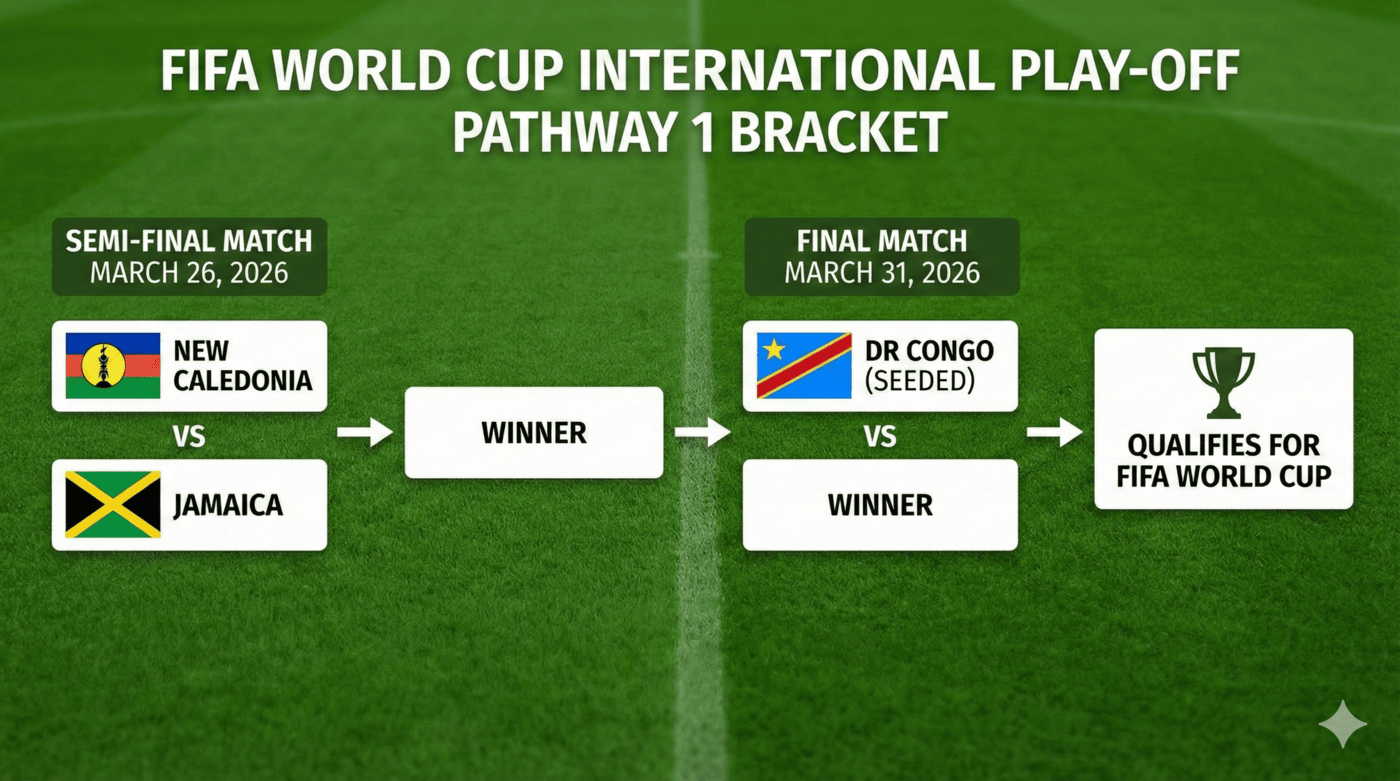
There is also a structural twist: seeding matters. The best-positioned team in each pathway goes straight to the final. In Pathway A, that advantage belongs to DR Congo, who enter at the last step and wait for the semifinal winner.
Official format, host city, and schedule
Pathway A is played in Guadalajara, with a semifinal on Thursday, 26 March 2026, and the final on Tuesday, 31 March 2026. Each match is single-leg. If level after 90 minutes, it goes to extra time and then penalties if needed.
| Date | City | Match | Round | Local time |
|---|---|---|---|---|
| 26/03/2026 | Guadalajara | New Caledonia vs Jamaica | Semifinal (M1) | 20:00 |
| 31/03/2026 | Guadalajara | DR Congo vs Winner of M1 | Final (M3) | 15:00 |
The three teams — no fluff, just the reality of the bracket
New Caledonia arrive with the unique pressure of being immediately in a do-or-die semifinal. In a two-game route, there’s no “settling in”: the campaign starts at full intensity.
Jamaica are the team forced to take the narrow path the hard way: semifinal first, then final. Practically, that means managing 90 minutes of maximum tension knowing the reward is not rest — it’s an even heavier match four days later.
DR Congo are the seeded side in this pathway. They gain the obvious benefit (one fewer match), but inherit a real risk: facing an opponent who has already played a high-pressure knockout in the same venue days earlier — an opponent who arrives sharpened by survival.
Competitive reading: what usually decides a pathway like this
In short knockout routes, matches tend to swing on three pillars:
-
First goal management In a single-leg tie, 1–0 isn’t just a score — it’s a script change. The team in front can choose tempo; the team behind starts bargaining with the clock.
-
Discipline and emotional control Not as a slogan — as mathematics. A rash challenge, a second yellow, an avoidable error becomes terminal here. There is no second leg to “pay it back.”
-
Set pieces and ruthlessness With tiny margins, the team that turns its best spell into a goal often survives. You don’t need to dominate 90 minutes. You need to cash in when the window opens.
Match-by-match: a practical preview
Semifinal: New Caledonia vs Jamaica
The opening truth is simple: lose and you’re done. In that setting, the first 30 minutes often become a risk-control duel. Nobody wants to gift a cheap goal, but conceding too much territory can trap you in your own box for long stretches.
Prediction (plain language): Jamaica win. Why: In a one-off knockout, the cleaner decision-making team usually edges it. Jamaica’s immediate incentive is to keep the game structured, avoid chaos, and let the match come to them rather than forcing it early. If it stays tight and stretches into extra time, the odds of it being decided by one moment (a set piece, a penalty) rise sharply.
Final: DR Congo vs the semifinal winner
Here is where the “one match fewer” advantage gets tested. DR Congo arrive fresher; the opponent arrives with 90 (or 120) minutes of knockout stress already in their legs — but also with match sharpness and recent emotional proof they can survive.
Prediction (plain language): DR Congo win. Why: The bracket is built to reward the seeded team with a measurable edge: fewer minutes, fewer chances for something to go wrong before the decider. That doesn’t guarantee the outcome — it tilts the board.
What the winner earns — and what the loser leaves behind
The winner of Pathway A claims one of the two Intercontinental Play-off World Cup places. And there’s a key competitive detail: qualification arrives just months before the tournament begins. It’s a direct jump from a must-win knockout to the biggest stage in the sport.
Editorial view
At the World Cup, narratives are written over weeks. In a pathway like this, they’re written in moments. Pathway A doesn’t reward long arcs or “good phases.” It rewards composure, clarity about when to attack and when not to overreach, and the ability to turn one action into one goal.
The classic trap in mini-tournaments is believing “there’s still time.” There isn’t. Here, the clock doesn’t accompany you — it squeezes you. That’s what makes this route so compelling and so cruel: two nights that separate a team from the World Cup… or from a memory that doesn’t fade until the next cycle.