






New Zealand - Grupo G
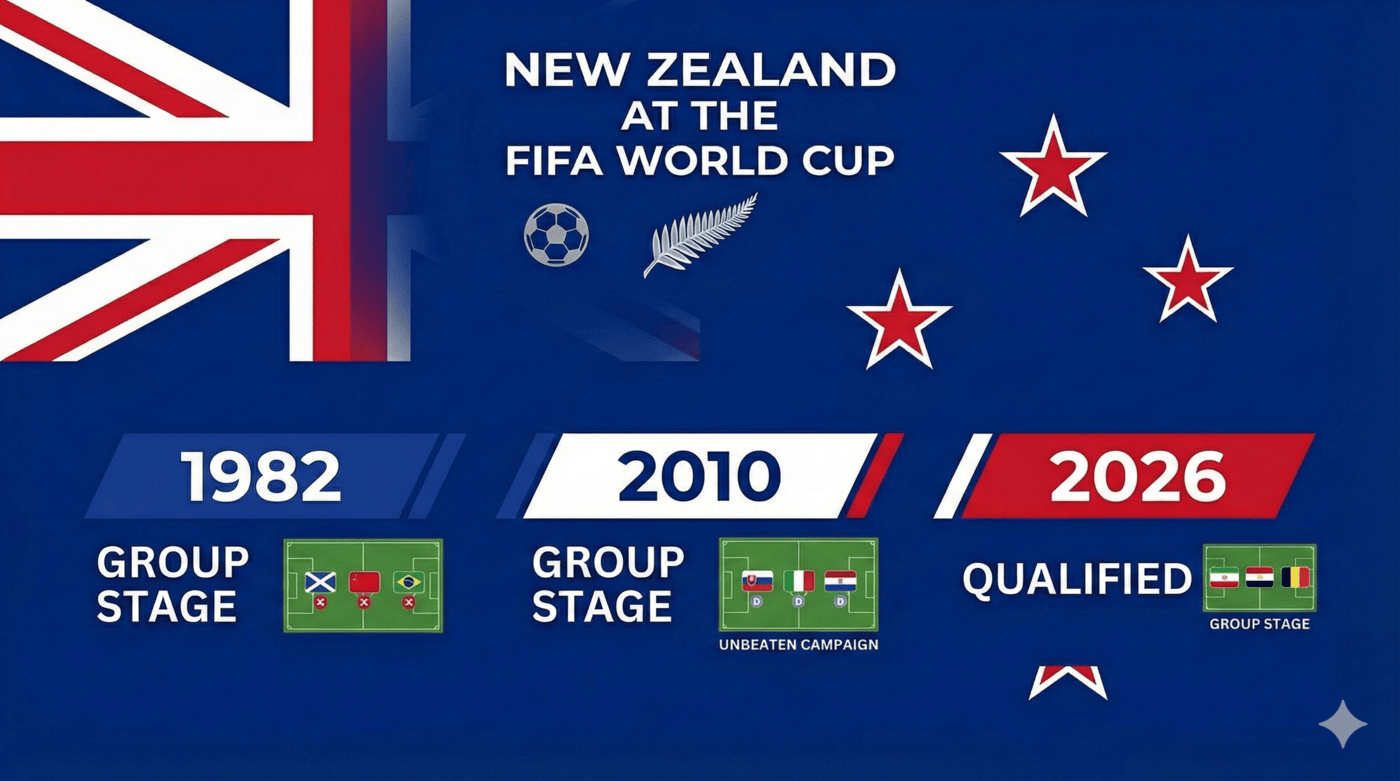
New Zealand’s long stride to 2026 🇳🇿⚽️🌍
A qualifying run with avalanche scorelines, a defense that barely blinked, and a World Cup group that demands the same ruthless focus.
Introduction
There are national teams that qualify with a calculator, a clenched jaw, and a suitcase full of “must-not-lose” draws. New Zealand walked a different road: boots on the gas, goal difference as a calling card, and matches that felt decided long before the final whistle. When the All Whites found daylight, they didn’t just step through it—they ran.
It started with a professional, no-fuss opening: a 3–0 against Tahiti on 11 October 2024. Not a match for poetry, perhaps, but one for habits: strike early, keep the sheet clean, and let the opponent spend the night chasing shadows. That first clean win set the tone for everything that followed.
Then came the kind of scoreboard that resets a whole group’s mood. On 15 November 2024, New Zealand tore into Vanuatu 8–1. It wasn’t only the eight; it was the way the goals stacked up—waves, not sparks. One week you are negotiating a match; the next, you are dictating it. The All Whites did the dictating.
And when the campaign needed an exclamation mark, they brought a whole paragraph. On 18 November 2024, listed as an away match against Samoa, New Zealand won 8–0. Again: not a narrow escape, not a late swing—an outright takeover, with the clean sheet as the quiet luxury at the end.
From the table, the story is blunt and bright. New Zealand finished top of their standings group with 9 points from 3 matches, a perfect record of 3 wins, 19 goals scored, 1 conceded, and a +18 goal difference. Those are not just numbers; they are a statement about control and distance—how far they stood from everyone else in the same lane.
Three hinge moments define the run in snapshots. First, the opener: 11 October 2024, New Zealand 3–0 Tahiti—early calm, late closure. Second, the eruption: 15 November 2024, New Zealand 8–1 Vanuatu—proof of ceiling. Third, the reminder that “away” can still feel like home when your rhythm travels: 18 November 2024, Samoa 0–8 New Zealand—authority without concessions.
The Road Through Qualifiers
Oceania qualifying can be unforgiving in a unique way: not because the margins are small, but because the best team is expected to win big and win often. It’s a region where the strongest side must carry not only results, but a standard—turning superiority into points without allowing any odd afternoon to become a trapdoor.
Within the data provided, New Zealand’s qualifying route is captured through a group standings table and a run of matches that read like a continuous ascent. The group phase portion is crystal-clear: three games, three wins, nineteen scored, one allowed. That last number matters as much as the first, because it tells you the All Whites didn’t merely outgun opponents—they controlled the risk of randomness.
In that standings context, Tahiti were the closest pursuer on 6 points, with a +2 goal difference. That’s the clearest competitive reference point: New Zealand didn’t just edge Tahiti; they left them three points behind and sixteen goals behind on goal difference (+18 vs +2). In a short group phase, that is separation you can feel in training sessions, in substitutions, in how early you can manage minutes.
Below them, Vanuatu collected 3 points and Samoa finished with 0. The goal totals underline the gap: Vanuatu scored 5 but conceded 11; Samoa scored 1 and conceded 15. New Zealand’s “19 for, 1 against” sits like a different sport. The group wasn’t close. New Zealand made sure it never became close.
The matches list also includes a “third round” pair in March 2025: a 7–0 against Fiji on 21 March 2025 and a 3–0 away win against New Caledonia on 24 March 2025. These results extend the same theme: New Zealand’s attack stayed heavy, and the defense stayed locked. Even when the scoreline returned to a more restrained 3–0, the clean sheet remained non-negotiable.
If you look at the scoring texture of the campaign, the All Whites weren’t living on one type of win. They could win with early punches (a goal at 2 minutes against Tahiti; a goal at 6 minutes against Fiji) and they could win with second-half weight (goals at 74’, 82’, 89’ against Vanuatu; a late penalty and stoppage-time strike against Samoa). That’s the mark of a team that can control different phases, not just blow opponents away with a single burst.
There’s also a telling blend of “star finishing” and “system finishing.” Yes, you have a clear main scorer in the match sheets, but you also have defenders and midfielders on the board, an own goal forced through pressure, and goals arriving across multiple minutes and game states. When a team can score at 11’, 23’, 24’, 31’, 38’, 74’, 82’, and 89’ in the same match, it usually means the opponent is being solved repeatedly, not just once.
Table 1: New Zealand match log
| Date | Round | Opponent | Venue | Result | Scorers | Stadium | City |
|---|---|---|---|---|---|---|---|
| 11 October 2024 | Second round | Tahiti | Home | New Zealand 3–0 Tahiti | Just (2'), Wood (67'), Waine (89') | Freshwater Stadium | Port Vila, Vanuatu |
| 15 November 2024 | Second round | Vanuatu | Home | New Zealand 8–1 Vanuatu | Garbett (11'), Wood (23', 24'), Bindon (31'), Kaltack (38' og), Just (74'), Singh (82'), McCowatt (89'); Tasip (17') | Waikato Stadium | Hamilton, New Zealand |
| 18 November 2024 | Second round | Samoa | Away | Samoa 0–8 New Zealand | McCowatt (24'), Wood (28', 34', 60'), Stamenic (62'), F. de Vries (75'), Just (87'), Waine (90+2' pen.) | Mount Smart Stadium | Auckland, New Zealand |
| 21 March 2025 | Third round | Fiji | Home | New Zealand 7–0 Fiji | Wood (6', 56', 60'), Singh (16'), Bindon (23'), Payne (32'), Barbarouses (73') | Regional Stadium | Wellington, New Zealand |
| 24 March 2025 | Third round | New Caledonia | Away | New Caledonia 0–3 New Zealand | Boxall (61'), Barbarouses (66'), Just (80') | Eden Park | Auckland, New Zealand |
The venue fields tell a small story inside the big one: some matches are labeled “home” but played in Port Vila; another is labeled “away” but played in Auckland; New Caledonia are “home” at Eden Park in Auckland. Rather than over-reading it, the safest conclusion is this: New Zealand handled whatever administrative geography existed around the fixtures, and their performance level did not dip. The opponent changed; the script barely did.
Table 2: Standings table
| Group | Pos | Team | Pts | Played | W | D | L | GF | GA | GD |
|---|---|---|---|---|---|---|---|---|---|---|
| Group B | 1 | New Zealand | 9 | 3 | 3 | 0 | 0 | 19 | 1 | +18 |
| Group B | 2 | Tahiti | 6 | 3 | 2 | 0 | 1 | 5 | 3 | +2 |
| Group B | 3 | Vanuatu | 3 | 3 | 1 | 0 | 2 | 5 | 11 | -6 |
| Group B | 4 | Samoa | 0 | 3 | 0 | 0 | 3 | 1 | 15 | -14 |
Now, the performance breakdown from the matches is almost too clean. Total goals scored across the five listed games: 29. Total conceded: 1. That is a +28 differential across those fixtures. Even if you strip away the biggest blowouts and look for “competitive tension,” you still find the same pattern: a 3–0, a 3–0, a 7–0. This wasn’t a team surviving moments; it was a team manufacturing them.
Home and away labels aside, the match list gives two away games: Samoa and New Caledonia. New Zealand won them 8–0 and 3–0. The away profile is therefore not conservative—it’s assertive. And the defense travels: two away clean sheets, no concessions, no need for a late rescue.
The one goal conceded in the set came during the 8–1 win over Vanuatu, with Tasip scoring at 17’. That timing is important: it happened early, when a match can still wobble. New Zealand’s response was not panic; it was accumulation. They still scored eight and turned the game into a lesson on depth, tempo, and finishing.
The second-half finishing is another consistent thread. Against Tahiti, two of the three goals came at 67’ and 89’. Against Vanuatu, three late goals came at 74’, 82’, 89’. Against Samoa, late goals came at 87’ and 90+2’. Against Fiji, the final goal arrived at 73’. New Zealand didn’t just start fast; they ended hard. That matters in tournament football, where matches often hinge on the last twenty minutes.
How they play
New Zealand’s identity here can be read from the simplest evidence: scorelines that keep swelling. This is a team that doesn’t treat a 2–0 as a reason to coast. When the All Whites find a lead, the next objective is to widen it—either through sustained pressure, repeated entries, or simply maintaining attacking intent until the opponent breaks again.
The numbers back that up. In five matches, New Zealand scored 29 goals: an average of 5.8 per game. Three of those matches hit seven goals or more for New Zealand alone (8, 8, and 7). That isn’t “efficient football” in the minimalist sense; it’s volume football—producing enough chances that the opponent’s resistance eventually gets overwhelmed.
Defensively, the campaign reads like a locked door with one brief creak. One goal conceded in five matches is not only an excellent defensive record; it is a control record. It suggests that New Zealand spent long stretches in positions where the opponent could not build sustained attacks. Clean sheets against Tahiti, Samoa, Fiji, and New Caledonia—four shutouts—also imply consistency across different match contexts, not a one-off.
The rhythm of scoring suggests a side comfortable in both early control and late punishment. New Zealand scored inside the first six minutes twice (2’ vs Tahiti, 6’ vs Fiji). That points to strong starts: readiness, intensity, and likely directness in the opening phase. But the late goals show the other side of it: fitness, bench impact, and a refusal to let the match drift. When you’re still scoring at 89’ and 90+2’, you’re not negotiating—you’re finishing the job.
Goal distribution gives another clue: this is not a one-man story, even if one striker stands out. Chris Wood appears repeatedly and heavily: he scored against Tahiti (67’), scored twice against Vanuatu (23’, 24’), scored a hat-trick against Fiji (6’, 56’, 60’), and scored three against Samoa (28’, 34’, 60’). That volume hints at a focal point in the box—someone the team can find again and again when the game becomes about conversion rather than creation.
But alongside Wood, the goals spread: Just scores in three different matches (including an early goal at 2’ and a later one at 80’); Waine scores late and even converts a stoppage-time penalty; McCowatt scores in two matches; Singh, Bindon, Barbarouses, Boxall, Payne, Garbett, Stamenic, and F. de Vries all appear. There’s even an own goal forced from pressure against Vanuatu. That’s a healthy sign for tournament football: if one route is closed, another can still open.
The vulnerabilities, in this dataset, are not many—but there is one clear cautionary scene. The only concession came at 17’ against Vanuatu. Conceding early can change the emotional temperature of a match, especially against higher-level opponents who won’t collapse after the first wave. New Zealand responded emphatically that day, but the lesson is still relevant: a small lapse in the opening phase can create a problem that isn’t solved by “eventually scoring eight” when the opposition is stronger.
Another potential vulnerability is psychological rather than technical: living in blowouts can reduce exposure to tight endgames. The match list contains no 1–0s, no 2–1s, no late defensive stands protecting a one-goal lead. That doesn’t mean New Zealand can’t do it. It simply means the evidence here speaks more about dominance than about suffering—and World Cup groups usually require at least one match that must be managed with patience.
The Group at the World Cup
Group G puts New Zealand into a three-game arc with distinct atmospheres, even before you talk about opponents. The opener is in Los Angeles at SoFi Stadium. Then the next two matches are in Vancouver at BC Place. That shift matters: a team can settle into a base, routines, and recovery patterns after the first match—especially when two games share the same city and stadium.
The fixtures provided are direct and complete: Iran vs New Zealand on 15 June 2026, then New Zealand vs Egypt on 21 June 2026, then New Zealand vs Belgium on 26 June 2026. That sequence shapes the group’s psychology: begin with a match where New Zealand are not listed as the “home” side, then two matches where they are listed first. It’s a small detail, but it often changes how teams imagine the game script.
Here, caution is necessary: the dataset includes no match results for Iran, Egypt, or Belgium, and no qualifying numbers for them. That means any talk of their form would be guesswork. So the most honest preview is built around New Zealand’s own profile: a team that scores in clusters, concedes almost nothing in the sample, and tends to keep adding goals late.
The opener against Iran is the one that will test New Zealand’s ability to translate dominance into patience. In qualifying, the All Whites frequently turned matches into wide-open spaces after the first breakthrough. In a World Cup group, the breakthrough may not arrive early, and the opponent may punish the first error. The key for New Zealand is to keep the game in their tempo: avoid gifting an early goal, and make sure the match does not become a chase.
The second game, against Egypt in Vancouver, looks like the kind of fixture where New Zealand’s late scoring trend could become decisive. If the match is level around the hour, the All Whites’ habit of scoring at 73’, 80’, 87’, 89’, and 90+2’ is not a trivial pattern—it’s a competitive weapon. But it only matters if the defensive base stays intact. Clean sheets were the campaign’s backbone; they must remain the tournament’s anchor.
The third game, against Belgium, often becomes the group’s defining mirror: how good are you when the opponent can match your physicality, your speed, your finishing? Again, we won’t label Belgium’s strength here without supporting match data. But we can say this: New Zealand cannot rely on one scoring lane. Their best evidence is that they don’t have to. Multiple scorers across the campaign suggest options—set pieces, second runs, different match states.
Group matches table
| Date | Stadium | City | Opponent |
|---|---|---|---|
| 15 June 2026 | SoFi Stadium | Los Angeles | Iran |
| 21 June 2026 | BC Place Stadium | Vancouver | Egypt |
| 26 June 2026 | BC Place Stadium | Vancouver | Belgium |
Match-by-match, plain-language predictions, with New Zealand’s evidence as the spine:
- Iran vs New Zealand — draw. The opener carries the most volatility, and New Zealand’s qualifying sample doesn’t include many “knife-edge” games. A controlled point, with defensive discipline, fits the profile of a team that must settle into the tournament first.
- New Zealand vs Egypt — New Zealand win. If the match is still alive after halftime, New Zealand’s recurring late scoring pattern offers a realistic path to a decisive moment.
- New Zealand vs Belgium — Belgium win. Against the highest-tier opponent in the group, New Zealand’s margin for early concessions shrinks dramatically. The Vanuatu match provided the one warning sign: conceding early can change everything.
Keys to qualification, stated simply and concretely:
- Keep the first twenty minutes clean, especially after the one early concession at 17’ against Vanuatu that showed how quickly a match can change.
- Lean into the late-game edge: New Zealand scored repeatedly after 70’ across multiple fixtures, and that can turn one point into three.
- Spread the scoring responsibility: Wood is the headline finisher, but the campaign’s multi-scorer pattern is what makes New Zealand harder to read.
- Protect the clean-sheet habit: four shutouts in five matches is the clearest transferable strength into a group format.
Editorial opinion
New Zealand’s qualifying story isn’t subtle, and it shouldn’t be. This team didn’t “manage” its way through Oceania; it imposed itself with a kind of relentless clarity—score early, score late, and keep the opponent’s best moment from ever arriving. The table says +18 in three games; the match list says 29–1 across five. That’s not noise. That’s a competitive identity.
But the World Cup doesn’t reward identity alone; it rewards identity under stress. The one moment that should stay pinned to the dressing-room wall is minute 17 against Vanuatu, the only time the net moved against New Zealand in this set. In Oceania it became a footnote in an 8–1. In a group match, it can become the whole plot. If the All Whites carry one principle into 2026, it should be this: keep the door shut early, and the rest of their game—depth, finishing, late punch—has room to breathe.
The All Whites arrive with a qualifying resume that reads like a drumbeat: big wins, clean sheets, and a striker’s name that keeps repeating in ink. The narrative temptation is to dream in scorelines. The smarter version of that dream is to think in details: first touches, defensive restarts, concentration at 0–0, and what you do when the match does not open the way it did against Fiji or Samoa.
Because the campaign already delivered the warning inside the triumph. Tasip’s goal at 17’ didn’t derail New Zealand; it reminded them. The World Cup won’t ask for eight. It will ask for the next decision after a small mistake, and whether New Zealand can stay themselves when the game refuses to be easy.